Endophytes are typically defined as microorganisms, that inhabit the plant endosphere asymptomatically. They play specific roles in plant growth promotion and protection [1]. Endophytic microbes may help with nutrient acquisition, produce growth-enhancing hormones, fungicides, etc. Fruit endophytes can protect fruits against post-harvest diseases.
Blueberry fruits are consumed all over the world. They are also widely studied for their bioactive compounds [2], however, their endomicrobiota is not well studied, especially endophytes contained in the berries [3].
Surface-enhanced Raman spectroscopy (SERS) is a highly sensitive technique that enhances the Raman scattering of molecules supported by some nanostructured materials. Molecular characterization by SERS allows for easy separation of microorganisms and produces a lot of information about the composition of cells.
The aim of this study was to isolate endophytic microorganisms from commercially grown blueberries and to identify their molecular composition by SERS.
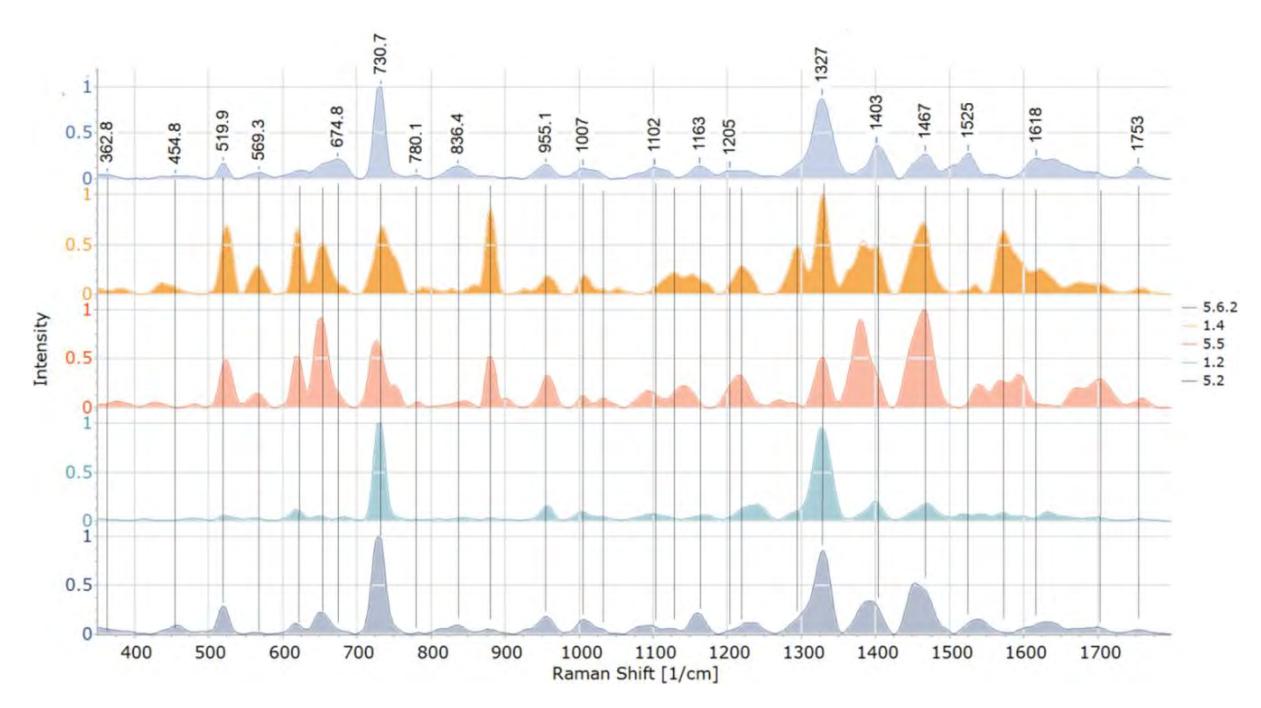
Fig. 1. SERS spectra (normalized to the highest peak) of all the bacterial isolates tested in this study at 532 nm excitation wavelength.
In this study, five microorganisms were isolated from blueberry fruit. It was 1.1 – C. santamariae, 5.5 – Salmonella enterica, 5.6.2 – L. mesenteroides, 1.2 – Staphylococcus hominis, and 5.2 – S. cohnii [4]. To our knowledge, Candida yeasts were not previously isolated from the blueberry endosphere.
[1] H. Rho, et al., Endophytes increased fruit quality with higher soluble sugar production in honeycrisp apple (Malus pumila), Microorganisms8, 1–17 (2020).
[2] P. Dró_et all., Evaluation of bioactive compounds, minerals and antioxidant activity of lingonberry (Vaccinium vitis-idaea L.) fruits, Molecules23, 53 (2018).
[3] M.P. Nguyen, et al., Host species shape the community structure of culturable endophytes in fruits of wild berry species (Vaccinium myrtillus L., Empetrum nigrum L. and Vaccinium vitis-idaea L.), FEMS Microbiol. Ecol.97, 1–13 (2021).
[4] D. Vaitiekūnaitė, et al., Endophytes from blueberry (Vaccinium sp.) fruit: Characterization of yeast and bacteria via label-free surface-enhanced Raman spectroscopy (SERS), Spectrochimica Acta Part A: Molecular and Biomolecular Spectroscopy275, 121158 (2022).