
General ecology and environmental protection are among the main priorities at this stage of industrial progress, taking into account sustainable development and reducing the impact on climate change. In general, the level of environmental pollution is increasing, in particular cases, especially in the developed regions of the planet, special measures are effectively applied to improve the environment both in the generation process itself and by reducing emissions in a specific environment. Atmospheric pollution has a special role, as it is the only habitat not only for humans, but also for a large part of wildlife. Changes in air quality due to emitted pollutants impair quality of life, contribute to various injuries and long-term illnesses, depending on the type of pollution. The most common pollution associated with fine and ultra-fine particles hovering in the open air [1]. The sources of this pollution are a large part of industrial production, road transport, energy, as well as various types of work, which inevitably spray or otherwise emit dust. The content of the generic term called particulate matter may vary depending on the type of activity in which they entered the atmosphere and the air stream. Thus, along with the mechanical effect of exposure, particles can also carry chemical components, which further aggravate the negative impact they create on the environment [2]. Most modern technologies quite effectively solve the problem of pollution with large solid particles, i.e., more than 10–15 μm. For such purposes, air flow filtration technologies are used as in air ducts using filters, including bag/cassette, some types of electrostatic precipitators, as well as centrifugal cyclones, sometimes cleaning using a water stream is used [1,3]. Only a part of filters is effective for settling or containment of fine dust, among which most of them require special operating conditions, have a narrow range of effective action, and their use requires special skills and personnel training.
In this paper, we study the apparatus of a new improvement, which in its design has several improved models of treatment technologies. The type of apparatus of each of the technologies is used in individual cases, however, such a solution is not effective and convenient with modern requirements for treatment facilities. The scientific object of this work combines in one building various stages of purification, operating according to different principles of work, but coordinated with each other. Thus, the use of such an apparatus is possible without preliminary primary purification of the gas flow, which makes it possible to effectively use this technology with a wide range of primary flow characteristics.
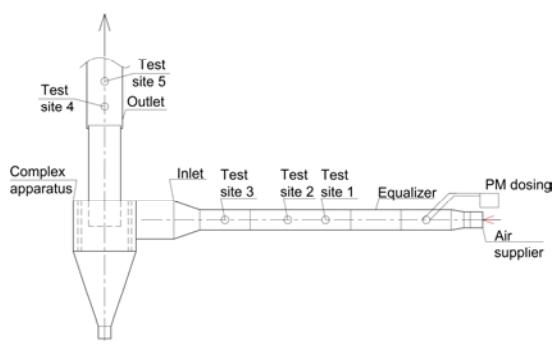
The studies described in this paper present experimental results on flow dynamics on a laboratory bench that simulates industrial conditions. The dependences of the gas flow rate in certain sections on the source of the generated flow to the inlet to the cleaning apparatus and the exit from it were studied. The aerodynamic parameters and the dependences of various characteristics on each other were studied at a gas flow rate in the range of 50–300 m3/h. The purification efficiency of the gas stream was investigated using fine and ultra-fine quartz solid particles. The total and fractional concentrations of particles before and after purification were studied for particles 0.3–10 μm in size. The overall efficiency of cleaning the gas stream from solid particles, according to preliminary data, exceeded 80%, and in particular, solid particles ranging in size from 2 μm to 10 μm in most cases were not detected in the stream after cleaning.