
Laser diodes (LDs) are widely used in communication, scientific and medicine applications, sensors and other systems as an effective light source. Infrared lasers are based on double separate confinement heterostructures with one or several quantum wells (QWs) in the active region. This enables a more advanced solution for achieving higher output power, lower threshold current. New solutions to improve LD characteristics and to increase their reliability are constantly being looked for. Therefore, new materials and new active region designs are investigated.
Diluting bismuth with group 3 to 5 semiconductor compounds to produce lasers has become very popular in many scientific researches. Bi modifies GaAs bandgap causing suppression of the non-radiative Auger recombination and significant reduction of the bandgap [1,2].
A detailed study of GaAsBi laser diodes with quantum wells between parabolic barriers grown with MBE technique using low frequency (10 Hz – 20 kHz) noise spectroscopy at temperature ranges from 88 K to 293K is presented.
Current-voltage characteristics of the investigated laser diodes show domination of the diffusion current. Low-frequency electrical noise spectra comprise from 1/f and Lorentzian noise components (Fig. 1), what is a result of superposition of charge carrier generation and recombination (GR) processes through different defects, dislocations and imperfections formed charge carrier trapping centers.
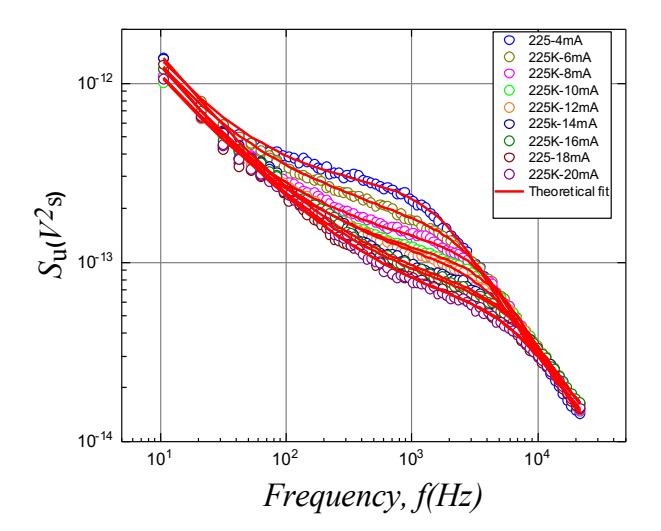
Noise spectra are well approximated by 1/f, $1/f^{\alpha}$ and two GR noise components:
$$S_{\text{el sum}}(f) = \frac{A_{1/f}}{f} + \frac{A_{1/f}\alpha}{f^{\alpha}} + \frac{A_{\text{gr1}}\,\tau_1}{1 + (2\pi f\tau_1)^2} + \frac{A_{\text{gr2}}\,\tau_2}{1 + (2\pi f\tau_2)^2}; \tag{1}$$here $A_{1/f}$, $A_{1/f^{\alpha}}$, $A_{\text{gr}}$ are, respectively, intensities of 1/f, $1/f^{\alpha}$ and GR noise components, f is frequency, and $\tau$ is characteristic time of the GR process. Lorentzian type components in noise spectra enabled evaluation of the activation energy of the observed active trapping centers responsible for the carrier capture and emission; it was found to be 16.0 meV and 20.4 meV.