Vitrimers are a class of polymers between thermosets and thermoplastics and therefore change their topology through a dynamic bond exchange that results in their self-healing and reprocessability [1]. This can solve the worldwide expanded manufacturing of thermosets and the fast use of fossil-based feedstocks and contribute to environmental protection. Vitrimers with dynamic covalent bonds that have undergone the most recent research are epoxy or acryl-based and rely on reversible transesterification reactions [2,3]. Over the past five years, there has been an increase in scientific publications involving biobased vitrimers. This draws attention from vitrimer researchers to the need to develop new biobased monomers for the synthesis of high-performance and sustainable materials. As monomers for various vitrimer synthesis reactions, functionalized triglycerides, lignin, vanillin, tannin, polysaccharides, and furan derivatives have already been used [4]. Glycerol, the main biodiesel by-product of the production from vegetable oil and animal fats, is appealing for vitrimer synthesis of vitrimers since it has properties such as low volatility, hygroscopicity, plasticization effect, high miscibility, compatibility with a variety of materials, stability, high viscosity, and nontoxicity [5].
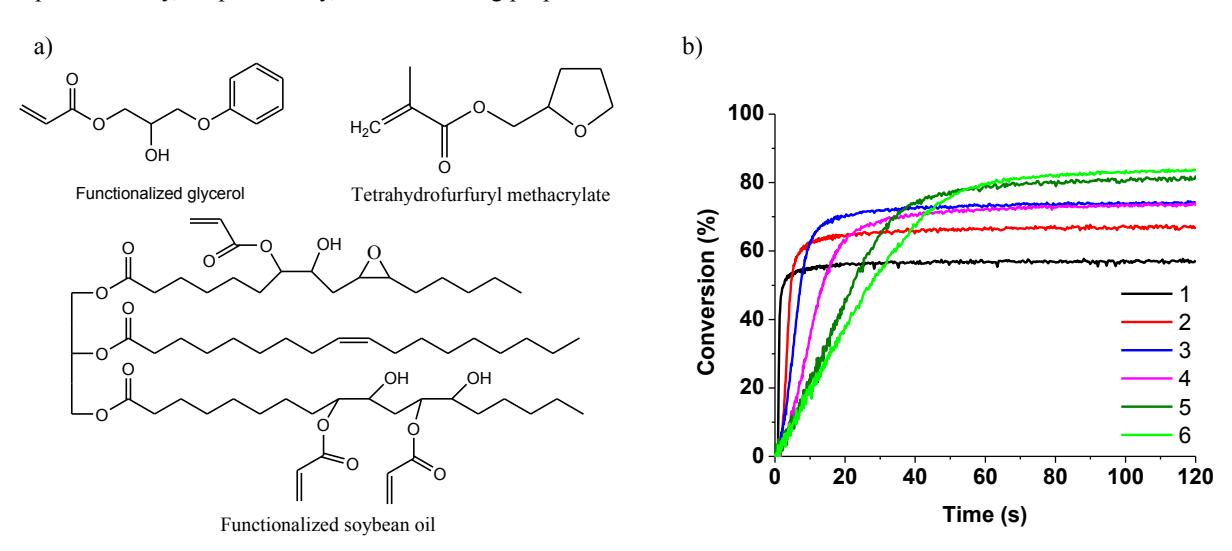
The aim of this research was to synthesize sustainable materials for an environmentally friendly strategy by combining the characteristics of renewable resources, glycerol, and vitrimers. Consequently, functionalized soybean oil, glycerol, and tetrahydrofurfuryl methacrylate (Fig. 1a) in different ratios were chosen for the preparation of UV-curable resins. The conversion of acrylate double bonds was estimated by FTIR on a Bruker Vertex 70 spectrometer and the highest value was (83.8 ± 3.3)% (Fig. 1b). Stress relaxation experiments performed on an Anton Paar MCR302 rheometer revealed that after UV curing, the dynamic networks were able to rapidly undergo thermoactivated network topology rearrangements. The rigidity of the vitrimers decreased slightly, the viscosity of the resin was reduced, and double bond conversion increased with increasing the amount of tetrahydrofurfuryl methacrylate. The synthesized vitrimers showed reprocessability, shape memory, and self-healing properties.