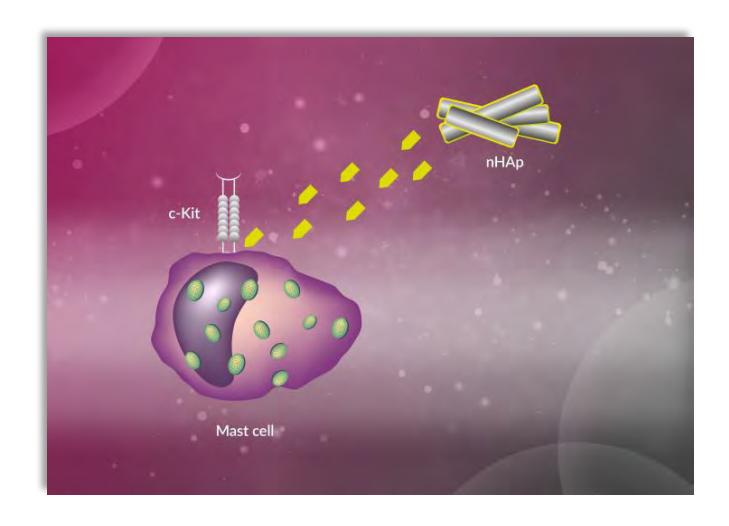
A promising approach to enhance the effectiveness of anticancer drugs related to reducing their side effects could be an use of nanoparticles for the controlled drug transporting the drugs to tumor sites [1]. Nanohydroxyapatite (nHAp) is a biocompatible material that is very suitable as a drug carrier. The studies have shown that the NI-1 cell line of canine mastocytoma, that has c-Kit tyrosine kinase mutations, is a good model for testing targeted therapeutic agents. There have been used the imatinib and toceranib as protein tyrosine kinase inhibitors (Fig. 1). The effectiveness of the proposed nHAp-drug system was tested in vitro. The results have shown the synergistic anti-tumor effect when the drug is delivered with nHAp in comparison to the effect of the drug alone [2,3].
The physicochemical properties of the obtained system were examined using XRPD (X-ray Powder Diffraction), SEM-EDS (Scanning Electron Microscopy-Energy Dispersive X-ray Spectroscopy), FT-IR (Fourier-Transform Infrared Spectroscopy), absorption spectroscopy and DLS (Dynamic Light Scattering) methods. The hydroxyapatite was identified as nanorod-shaped particles with great crystallinity and the amorphous drug was obtained by transforming it from its crystal form. Time-dependent drug release from the nHAp-drug system was carried out.
Fig. 1. Schematic of the nHAp-drug delivery system to mastocytoma cells.
Acknowledgments: The authors would like to acknowledge the National Science Centre, Poland (NCN) for their financial support within the project 'Preparation and investigation of multifunctional biomaterials based on nanoapatites for possible application in bone tumour treatment' (no. UMO-2017/27/N/ST5/02976). Paulina Sobierajska received financial resources within the confines of financing the ETIUDA doctoral scholarship from the National Science Centre, Poland (NCN) (no. UMO-2018/28/T/ST5/00326). Anna Serwotka-Suszczak obtained funding from the National Science Center, Poland as part of the Miniatura project entitled 'Initial research is planned as part of the project to assess the impact of including toceranib in the basic structure of Pt-based anti-cancer drugs (cis-platinum, oxaliplatin and transplatin)' (no. 2019/03/X/NZ5/01138).
[1] I. Brigger, C. Dubernet, P. Couvreur, Nanoparticles in cancer therapy and diagnosis. Advanced Drug Delivery Reviews54 631–651 (2002)
[2] P. Sobierajska, A.Serwotka-Suszczak, S. Targonska et al., Synergistic Effect of Toceranib and Nanohydroxyapatite as a Drug Delivery Platform—Physicochemical Properties and In Vitro Studies on Mastocytoma Cells, International Journal of Molecular Sciences23, 1944 (2022)
[3] P. Sobierajska, A.Serwotka-Suszczak, D. Szymanski et al., Nanohydroxyapatite-Mediated Imatinib Delivery for Specific Anticancer Applications, Molecules25, 4602 (2020)