
Hydrogel materials are becoming increasingly common in medicine. Current development in this field shows a trend towards creating hydrogel materials based on natural polymers. The advancement is explained by the fact that natural polymers are tolerant to the human body. The newest and latest implementation way of hydrogel foam-based material relies on a producing intra-abdominal dressing by unique conception that promotes hemostasis and prevents the infection of a wound. A significant number of deaths from penetrating wounds of the abdominal cavity are associated with internal bleeding and wound infection. In non-hospital conditions, the situation becomes critical quickly or even ends fatally. Applying macroporous hemostatic remedy features stops internal bleeding, prevents sepsis and preserves the damaged internals for safe transportation of injured body.
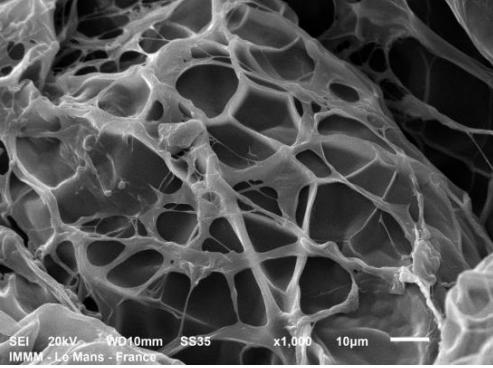
The regularities of forming alginate macroporous hydrogel materials for invasive medical purposes based on experimental data have been studied in this work. The macroporous material was formed by a chemical method based on two major processes in parallel, namely the liquid foam formation and liquid foam templating. Foaming occurs due to the interaction between sodium bicarbonate and the carboxyl groups of sodium alginate and polyacrylic acid. The way alginate macromolecules are structured by calcium ions implemented into polyacrylic acid proceeds the gelation of liquid foam simultaneously. It leads to the formation a highly porous hydrogel which must be considered a foam. The composition contains 3% water solution of sodium alginate with added sodium bicarbonate powder and a calcium salt of polyacrylic acid with plasticizers and surfactant. Figure 1 represents the micro photo of the xerogel material obtained under the research.
In particular, the issues of generating macroporous structures due to coordination of the gelation kinetics and the rate of release of the foaming gas were considered. The challenge of optimal surfactant selection for dispersion adjusting of the product was investigated with increased focus. Cocamide Monoethanolamine, commonly known as Cocamide MEA, as a highly prevalent surfactant and foaming agent, triggers a significant surface tension decrease as the graph implies, even with a compound content within (0.5% - 1%).
Additional research has been conducted to determine the release kinetics of selected drug compounds such as antimicrobials and analgesics from the elaborated foam material. The compositions developed during the work are the basis for the formation of abdominal foam dressings with hemostatic and antiseptic properties or xerogel porous surgical dressings.