
With hundreds of deaths and thousands of new infections every day in the US alone, COVID-19 will take time to transition from a pandemic to an endemic. [1] One of the leading means of coronaviruses spreading is through the frequently touched surfaces (FTS) such as door handles or handrails. [2]
These pathogens have an envelope covered by protein spikes responsible for adsorbtion to surfaces. [3] Presuming we can obtain and cover FTS with coatings that have repelling properties towards the proteins, a restriction of coronaviruses spreading could be ensured.
To become aware of how proteins adsorb to coatings, we detected bovine serum albumin (BSA) adsorbtion using Surface-enhanced Raman spectroscopy (SERS) method. SERS was chosen as an eligible method with the known general ability to detect small concentrations of the substance (seeking up to 10-10 – 10-15 mol/l). It currently has a wide field of applications in various studies surrounding biological objects. [4]
Firstly, to optimize experimental conditions, a SERS must-have standard Lee-Meisel colloid [5] was prepared and then concentrated using centrifugation. After this, five clean and differently coated plates were soaked in a BSA solution for 10 minutes, rinsed and left to dry. The following day, a drop of colloid was dried on top of it too and the coating was ready for testing.
FT-Raman spectrometer with an excitation laser of 1064 nm wavelength was used to execute the experiment. Ring vibrations with a 1003 cm-1 band were observed at the albumin SERS spectra. While studying a specimen on a reflective aluminum plate surface, this characteristic band was visible even at the albumin solution's concentration as low as 10-9 M (fig. 1).
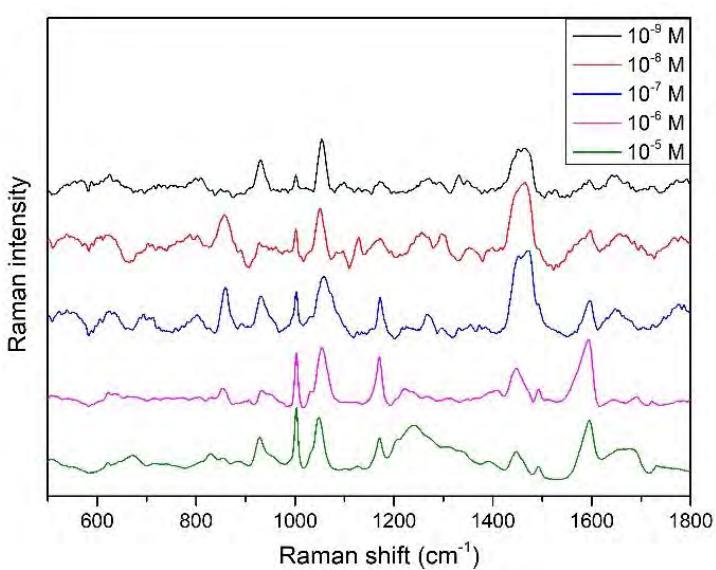
After further measurement of protein adsorption on five different test coatings, variation of band intensities was observed with the weakest when using coating named Coating from Cu mixed with SiO2 + Ag.
Hence the purpose of our study is to optimize the experimental conditions for protein adsorbtion detection using SERS method and to test the given plates. Assuming we observe a weak or void characteristic band amongst the test coatings, these could be considered having antiviral properties and suitable for the FTS.