According to the report of World Health Organization (WHO, 2021), 99% of the global population breathes air that exceeds WHO guideline limits and contains high levels of pollutants [1]. In urban environment, carbonaceous aerosol particles are the major component of fine particulate matter (PM2.5) [2]. Formed during the combustion process (e.g. biomass burning, emissions of internal combustion engines), Black Carbon (BC) particles are known to be especially harmful to human health. A better understanding about the sources of BC particles, its magnitude, and source specific concentrations, especially in economically developing countries is mandatory for the improvement of air quality and well-being. Raising the awareness about the prevailing environmental crisis is one of the first steps towards sustainable development.
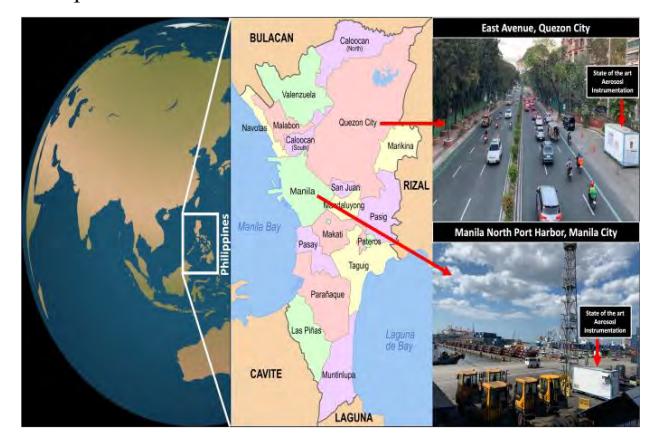
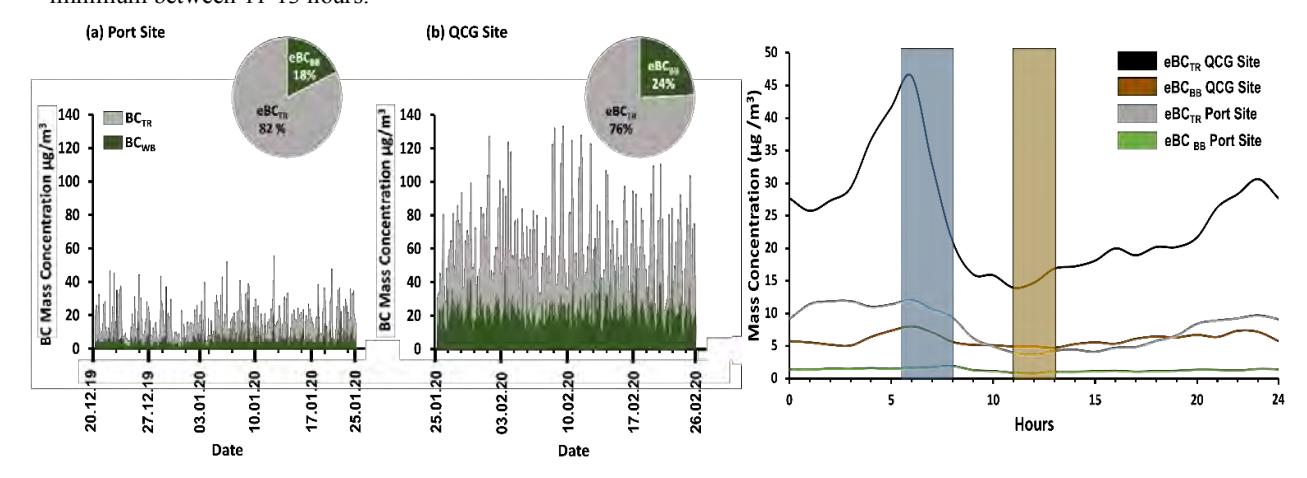
To raise the awareness about poor air quality due to unsustainable development, intensive field campaign focusing on BC, was conducted in Metro Manila, Philippines (as a part of project "A Transdisciplinary Approach to Mitigate Emissions of Black Carbon" (TAME-BC)). Equivalent black carbon (eBC) mass concentration was measured using 7-wavelenght Aethalometer (AE-31) during a period of 3 months (December 2019 to February 2020) in urban environments of Metro Manila: Quezon City's East Avenue roadside (QCG site) and Manila's North Port (Port site) (Fig. 1). To investigate the magnitude of air pollution in Metro Manila, the focus was set on the sources of eBC, as well as mass concentration variation. Wavelength dependent absorption coefficient analysis revealed that at Port site transport (eBCTR) and biomass burning (eBCBB) related eBC contribute approximately 82% and 18% to the total eBC mass, respectively. In the case of Quezon City, this contribution is 76% and 24%, respectively (Fig. 2a, 2b). The diurnal trend of eBCTR at both sites (QCG and Port site) indicated a higher mass concentration during the morning hours (6-8 h) and a lower mass concentration during the midday (11-13 h). Both sites (QCG and Port) showed a similar trend for eBCBB mass concentration, which reached a maximum between 6-8 hours and minimum between 11-13 hours.