
Successful application of femtosecond laser breakdown spectroscopy (fs-LIBS) in surface hardness measurements could result in wide usage of the methodology, especially in micromachining.
Nanosecond-LIBS has showed great promise for surface hardness measurements in many scientific articles [1], however similar works using femtosecond pulses are absent. Since femtosecond pulses are used for their advantages in material ablation, fs-LIBS for surface hardness measurements could yield advantages in application compared to ns-LIBS.
LIBS spectra was gathered from different speciments, having known surface hardness values. Plasma was induced with 1030nm and 343nm wavelenght irradiation of Pharos femtosecond laser, pulsewidth 190fs, pulse energy of 0.13mJ. It is said that materials surface hardness has an impact on induced plasma temperature and ionisation degree [2], therefore we calculated plasma temperature Te, as well as ionic/atomic spectra line relation and displayed the results in graphs in relation to known surface hardness values. Shadowgraphy was used to visualize schockwaves and measure the schockwave speed, which was also displayed in relation to surface hardness values (Fig.1).
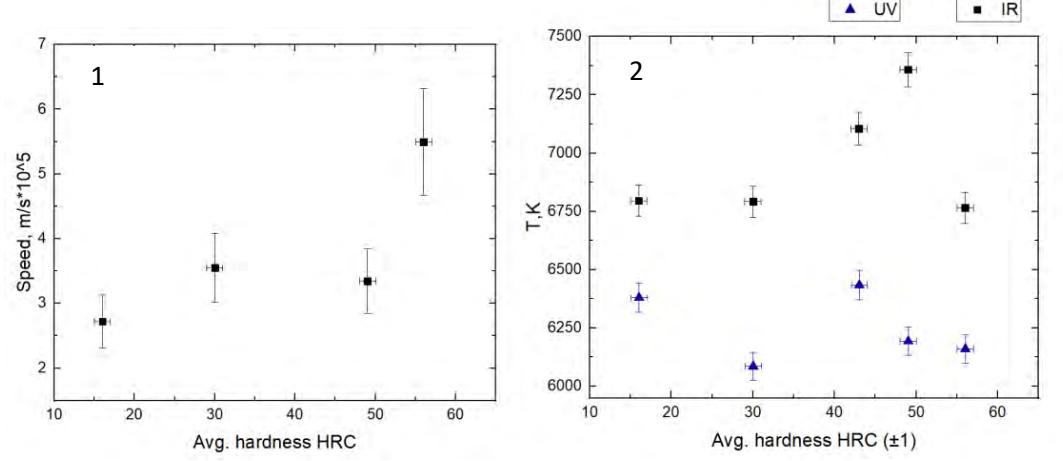
Using femtosecond infrared laser irradiation, evaluated plasma temperature values were higher than using ultraviolet light. In our case laser induced plasma temperature, as well as ionic/atomic spectra line ratio has no expressed dependence on materials surface hardness. Schockwave speed, however, tends to rise with surface hardness values.
The obtained results conclude that fs-LIBS could not be successfully applied for the measurements of materials surface hardness.