
The expectations for the use of GaN material for UV-blue light are still very high due to the great demand for lighting sources of high efficiency for various applications, such as automotive manufacturing, water cleaning, and communication technologies. Such high demand encourages extensive search for material improvements, for example, an extension of the spectral range of operation. The most used switching method for spectral range extension is optical harmonic generation. Conventional birefringent materials have got competing methods of satisfying the phase matching condition such as quasi-phase matching (QPM) [1] and modal phase matching (MPM).
In this work, we demonstrate a broadband second harmonic generator for green spectra, that is based on QPM structure - a GaN sample of periodical polarity grown via metalorganic chemical vapor deposition (MOCVD) using Aixtron CCS 3x2" reactor. A periodical polarity GaN (PPO-GaN) structure was fabricated with an alternating periodicity of 4 μm and thickness of 1.2 μm. From the measured second harmonic (SH) in the wavelength range of 500-550 nm, the evaluated SH (${\lambda}_{SH} = 512 nm$) conversion efficiency was 0.79 $\cdot$ 10-5 % $\cdot$ W-1 for the pump peak power of 44 kW.
The optical system used to observe and measure the second harmonic signal consisted of a 1kHz repetition rate femtosecond Ti:sapphire chirped pulse amplification laser system, providing 35-40 fs pulses centered at 790 nm with maximal pulse energy of 5 mJ, which was used to pump OPA in order to tune the wavelength between 950 and 1150 nm. The duration of a single OPA pulse energy was about 45 fs and 0.1-0.2 mJ.
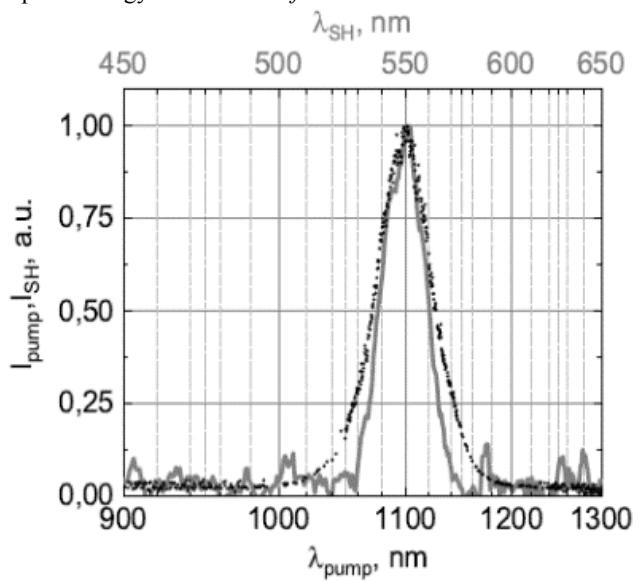
In Figure 1 we present the measured wavelength spectra of the 1100 nm pump and generated second harmonic (SH) pulse. The temporal and spectral characteristics of the pump pulse are defining the ~50 nm FWHM of the SH pulse spectra. There is a slight difference in the SH pulse compared to the pump pulse, which can be attributed to some incoherence of the pump at the slopes of the spectra.