
Solar simulators are tools that provide optical and spectral composition similar to sunlight intensity and are integral in the process of current – voltage (I-V) characterization of photovoltaic panels [1]. Compared to natural sunlight solar simulators have the advantage of being calibrated sources that can be changed on demand thus are not influenced by factors such as geographical location and climate conditions. Solar simulators have been traditionally manufactured using xenon short-arc lamps or metal halide discharge lamps; however, they require extensive maintenance and have a quite limited lifetime [2]. The development high-energy LED technologies has created new ways to design solar simulators that allow for the mitigation of the aforementioned issues due to the intrinsic properties of LEDs such as longevity, high efficiency and low operating voltages [3].
The "Sentaurus TCAD” program package consists of several programs out of which the most important one is "Sentaurus Device". It allows to simulate numerically the performance of semiconductor-based optoelectronic devices under various illumination conditions [4].
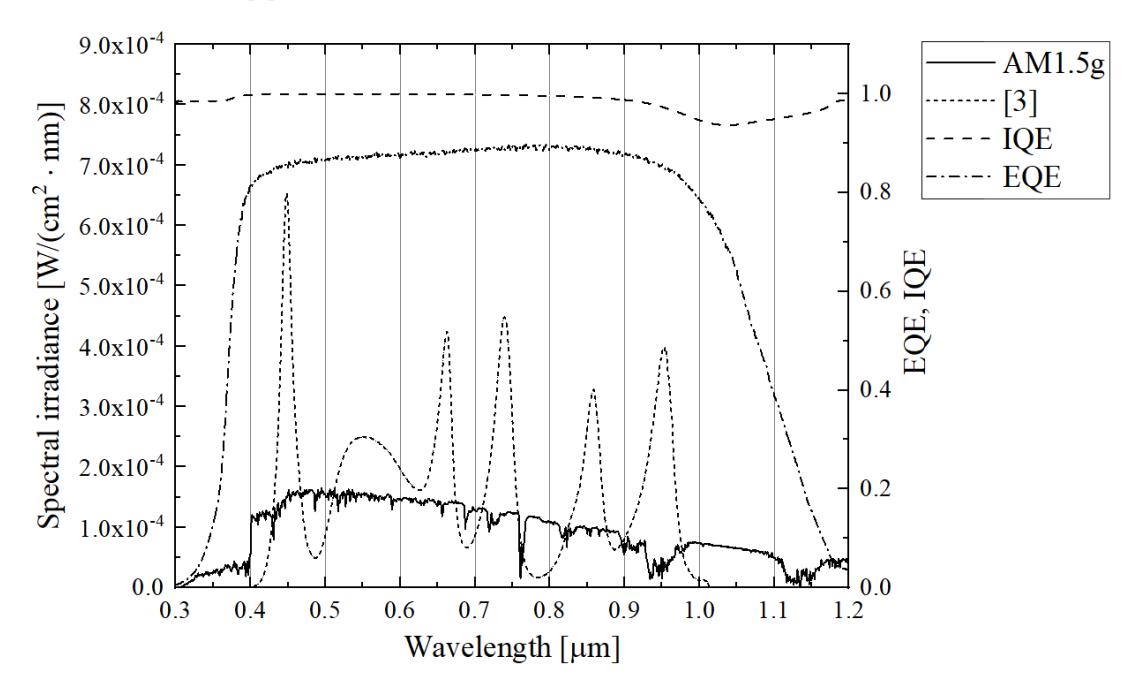
In this contribution, we report on the evaluation of expected performance of solar cells under the illumination of various spectra that were calculated for LED – based solar simulators with varying layouts: from solely LED – based to hybrid solar simulators. We performed simulations for multiple solar cell types, including both single-junction and dual-junction ones.
Our simulation results reveal that substantial photocurrent differences might be expected even when solar simulators fully match newly defined [5] requirements for so-called A+ class solar simulators and constant irradiance is enforced. The origin of these deviations can be traced back to spectral contents of simulators and peculiarities of response of solar cells for photon energies either near the absorption edge of semiconductors or in the regions of strong absorption neat the interfaces.