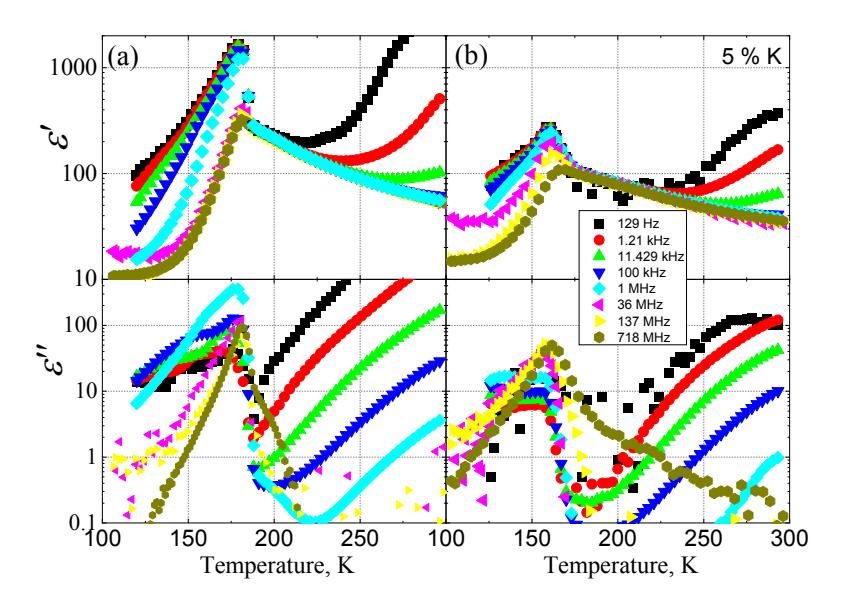
Over the years the dielectric properties of [NH4[Zn(HCOO)3]] formate metal framework has been investigated by academic community. Guan-Cheng Xu et al. in their research reported that paraelectric – ferroelectric phase transition for metal organic framework was at 191 K [1]. However, our initial investigation showed that added potassium dopants diffuse into the [NH4[Zn(HCOO)3]] structure, that lead to temperature drop for the paraelectric – ferroelectric phase transition and increase in activation energies.
In this presentation dielectric properties of ammonium zinc formate samples were being investigated. For pure and potassium doped [NH4][Zn(HCOO)3] frameworks dielectric permittivity dependence on temperature (100 – 300K) were measured, using flat capacitor method in the 102-106Hz frequency range which was illustrated in figure 1. At significantly high temperatures dielectric permittivity is dependent on frequency, which can be related to Maxwell – Wagner relaxation. Moreover, relaxations near phase transition temperatures can be linked to the motion of domain walls. We present inverse temperature dependence of logarithm of relaxation time, which was obtained by approximating frequency dependencies of dielectric permittivity, using the superposition of several Cole – Cole functions. Furthermore, the activation energies for relaxation for organic metal frameworks both pure (EA = 0.15V) and dopped with potassium (EA = 0.34V) were approximated following Arrhenius law. Increase in activation energies with K 5% impurities could have happen due to domain wall fixing to point defects, caused by potassium, which hinders its motion.