
Nucleic acid detection and quantification are crucial steps in many biotechnological and clinical applications, including disease diagnosis, genetic engineering, and personalized medicine. Current nucleic acid detection methods, such as polymerase chain reaction (PCR) and quantitative PCR (qPCR), usually employ optical signal readout methods [1]. Electrochemical readout could provide comparable or better sensitivity, specificity, cost-effectiveness, and simplicity, possibly faster sample-to-answer times. However, electrochemical nucleic acid sensors have limitations. One of the challenges – achieving clinically or technologically relevant detection limits – often requires complicated designs. The designs may involve surface damaging voltametric techniques (usually suitable only for end-point measurements) and the use of expensive nanomaterials.
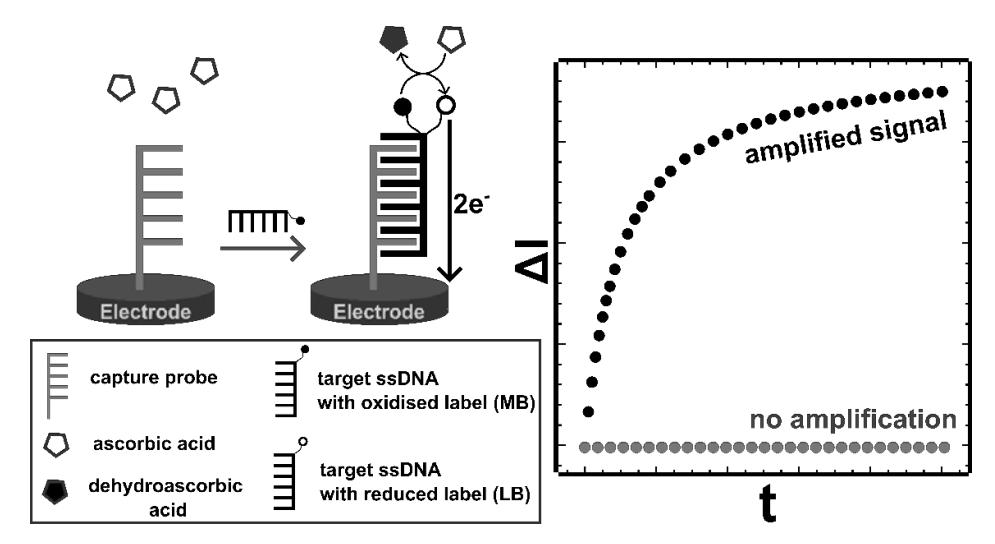
In this study, we developed an electrochemical system for real-time detection of nucleic acid hybridisation. The target, single-stranded DNA (ssDNA) labelled with methylene blue (MB), was captured at a gold electrode by an immobilized complementary probe, resulting in an increase in oxidation current during constant potential amperometry measurements. The detection was enabled by the use of ascorbic acid (AA) as a freely diffusing signal amplifier [2]. AA reduced MB to leucomethylene blue (LB), which was oxidized back to MB at the electrode by applying an appropriate potential, creating a cyclical electrocatalytic amplification of the signal (Fig. 1). The resulting biosensor provides real-time hybridisation measurements with 1-second temporal resolution, enabling electrochemical readout of a redox-tagged oligonucleotide hybridisation signal. When compared to previously used hybridisation evaluation technique that employed cyclic voltammetry without signal amplification [3], the new method offers several advantages: (1) temporal resolution was improved from 20 s to 1 s; (2) assay time was reduced from 15 min to 5 min; (3) LOD was reduced by half to 5 nM.
In summary, the development of this electrochemical hybridisation biosensor brings a new level of simplicity, sensitivity, and speed to nucleic acid detection and quantification. Real-time signal readout allows using this tool for studying heterogenous hybridisation. Such biosensors have the potential to greatly improve biotechnological applications by providing more efficient and accurate results cost-effectively.