
Products of natural origins, such as medicinal and aromatic plants, are becoming more and more popular and are used in today's society, as an effective remedy due to their healing properties and lower risk of side effects [1]. The healing properties of plants depend not only on the quantity and quality of accumulated biologically active substances but also on the part of the plant. The plant part may be related to the limited release of biologically active compounds due to the different matrices, such as leaves, stems, or roots. Literature shows, that the biological activity of plant raw materials can be increased during fermentation. It is a low-cost system that ensures food safety and quality [2]. During fermentation, several biochemical changes occur that can affect the biological activity of the final product [3]. The impact of fermentation on the release of biologically active compounds depends on several factors, such as the specie and strain of microorganisms used for fermentation, conditions of fermentation (pH, temperature, duration), and fermenting matrix. To our knowledge, there are no literature data about the impact of kombucha SCOBY (Symbiotic Culture of Bacteria and Yeast) fermentation on the roots and bark of several plants grown in Lithuania.
The impact of fermentation with kombucha tea fungus (Medusomyces gisevii) beverage on roots of elecampane (Inula helenium), common dandelion (Taraxacum officinale), and valerian (Valeriana officinalis), as well as on the bark and acorns of the common oak (Quercus robur) and the acorns of the red oak (Q. rubra) was evaluated in this study. The plant material was fermented with kombucha beverage. After 48 h the liquid part was collected and is called "kombucha fraction", while the residues were extracted with 75% methanol, and the obtained extract is called "methanol extract". The total amounts of phenolic compounds, flavonoids, and antiradical activity were evaluated in kombucha fractions and methanol extracts by spectrophotometric methods [4]. Control samples were prepared in a similar way, just distilled water was used instead of kombucha. Results were expressed as rutin equivalents (mg RE/g).
Fermentation with kombucha beverage increased the content of biologically active compounds in the tested plants The highest amount of phenolic compounds was determined in a fermented sample of common oak acorns (Fig. 1). The highest amount of flavonoids was detected in the fermented sample of common oak bark (2.22 and 3.54 mg RE/g before and after fermentation, respectively). An increase in anti-radical activity was found in all kombucha fractions after fermentation. However, the antiradical activity slightly decreased from 19.5 to 22.02 mg RE/g in the methanolic extract of common oak bark after fermentation.
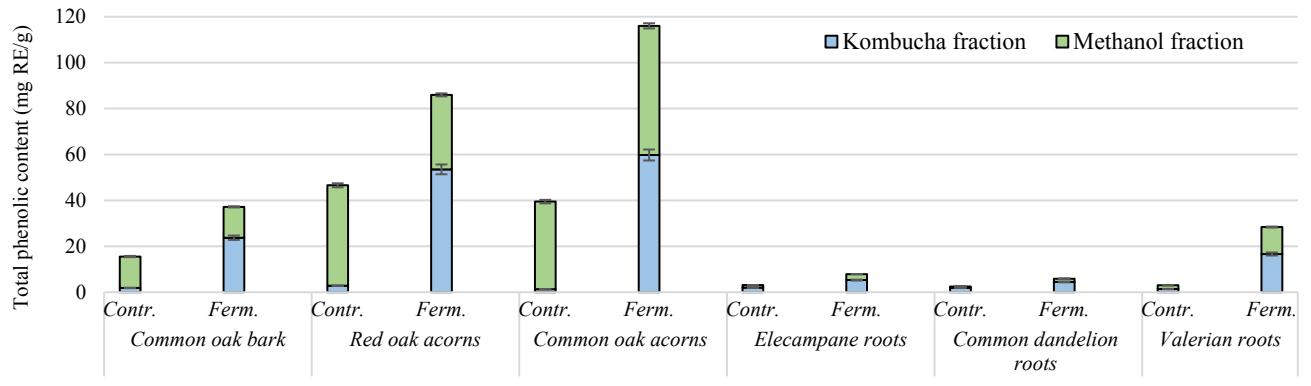
In conclusion, the fermentation had a positive effect on the sum of biologically active compounds determined in kombucha and methanol fractions together, where the content of biologically active compounds increased from 1.2 to 9 times. However, the variation activity of separate fractions was dependent on the plant.