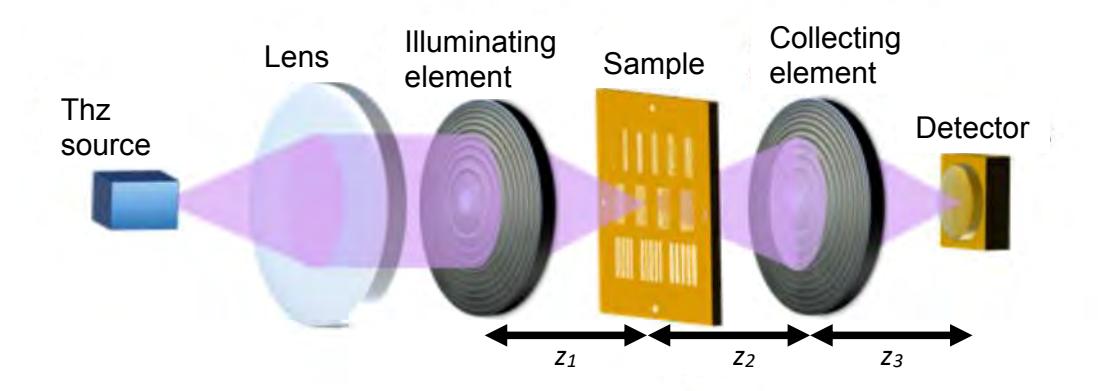
Electromagnetic THz radiation sources have attracted a lot of attention in the last decade due to their wide applications: from non-invasive spectroscopy [1] to non-ionizing sample imaging methods [2]. One of the more important areas of special applications of optics is the imaging of objects, their recognition and inspection of samples. Due to the complicated detection, Thz imaging is usually implemented by using one pixel method (see Fig. 1) i.e., by changing the position of the sample in the transverse plane. We tried to find the best resolution by changing the distances z1, z2 and by trying different configurations of the illuminating and light collecting elements (to reduce the degree of freedom, distance z3 was picked equal to 11.5mm and z1 was picked corresponding to the highest intensity of the beam). Four diffractive masks were investigated: zone plate, axicon, cubic (Airy) and Fibonacci lens. Resolution was defined by spatial frequency (measured in line pairs per millimeter) when the image contrast drops below 20%.
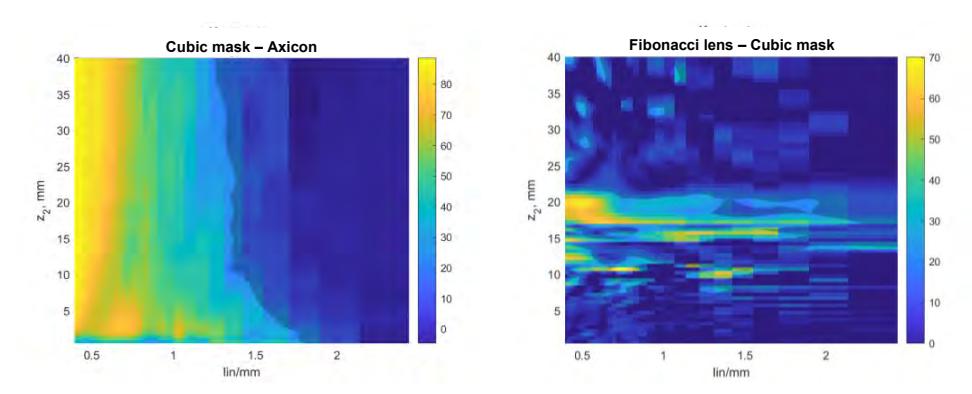
We found that some configurations (cubic mask – axicon, zone plate – axicon, cubic mask – cubic mask, where the first element is the illuminating element and the second is the collecting element) give broad zones of high resolutions while other configuration (Fibonacci lens – Fibonacci lens, Fibonacci lens – cubic mask) give very narrow zones of very high resolution, see Fig. 2. Hence the preference of one configuration over the other heavily depends on the context of the application. This work allows researchers to decide which single pixel Thz imaging configuration is most suitable for their research.