
Relaxors are a type of materials, that exhibit high dielectric constant and slim polarization hysteresis curves. For these reasons, they are widely used in capacitors [1] and RAM microchips [2]. Some of examples of such materials are lead magnesium niobate or lead scandium niobate. Such materials contain lead, which, when disposed inappropriately, can cause severe damage to the ecosystem and human health. One possible alternative to replace aforementioned composites are barium titanate-based compositions. In this report the x(Bi(Zn2/3 Nb1/3)O3)(1 – x)BaTiO3, x=3.6 - 7.0 % solid solution was studied. It was previously reported that the copmposition undergoes a ferroelectric-relaxor structural phase transition in the concentration range of 4.0 % < x < 5.0 % [3]. However, there is still uncertainty regarding the phase composition around the boundary. Additionally, the dielectric propeties were reported only for low frequency range.
The aim of present research is to investigate the dielectric properties of the samples by means of the dielectric spectroscopy methods in wide frequency (20 Hz – 40 GHz) and temperature (100 – 500 K) ranges. Ferroelectric and piezoelectric properties were studied using 100 Hz, 50 kV/cm alternating electric field in temprature range from 233 K to 423 K.
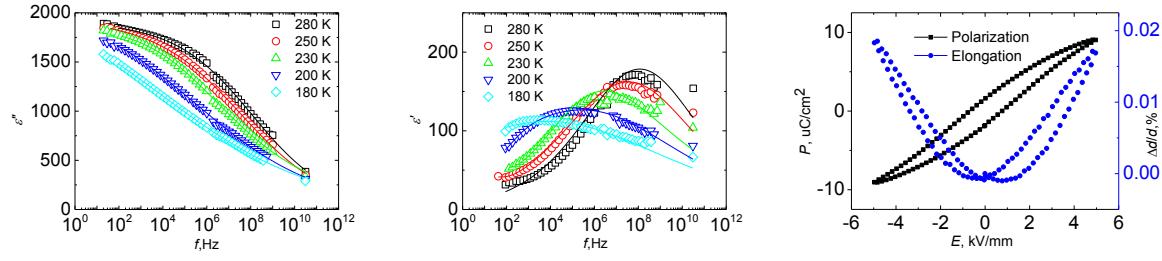
All samples demonstrate phase transition-related anomalies in the behavior of the dielectric constant. The spectra of dielectric permittivity demonstrate pronounced relaxation behaviour (see Figure 1). The imaginary part shows that maximum shifts towards lower frequencies as the temperature increases. The dependencies follows the Cole-Cole law:
$$\varepsilon^{\ast} = \varepsilon_S + \frac{\varepsilon_S - \varepsilon_\infty}{1 + (i\omega\tau)^{1-\alpha'}}\tag{1}$$here εs and ε∞ are static and infinite frequency dielectric constants, ω is the angular frequency, τ is relaxation time and α is an empirical parameter describing spectral shape. The hysteresis loops thinners gradually with the concentration of BZN. Depending on BZN concentration, the shape of elongation curves switches between piezoffect to electrostriction. (see Figure 1 right).