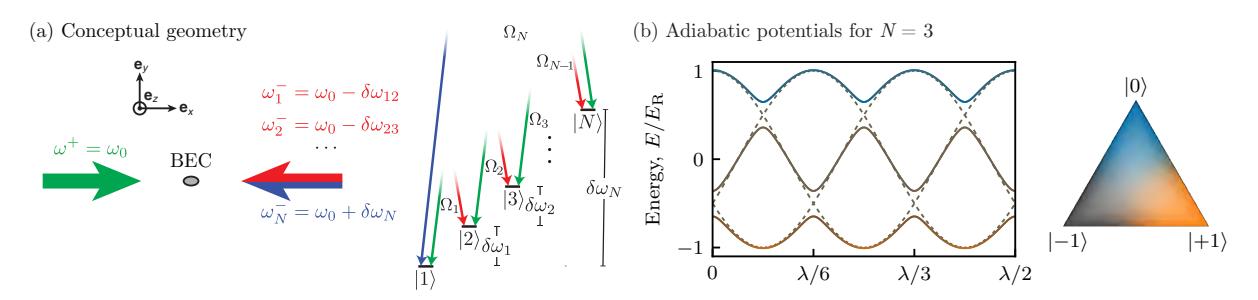
Ultracold atoms in optical lattices represent a unique platform for simulating various condensed matter phenomena as well as realizing paradigmatic models. However, conventional optical lattices for ultra-cold atoms rely on the AC Stark shift to produce a potential proportional to the local optical intensity. As a direct result, the lattice period cannot be smaller than half the optical wavelength $\lambda$. Recently, two techniques have emerged to create deeply sub-wavelength lattices [1, 2, 3]; both can be understood in terms of "dressed states" created by coupling internal atomic states with one- or two- photon optical fields.
Here we focus on a scheme, relying on sequentially coupling N internal atomic states using two photon Raman transitions. This results in an adiabatic potential for each of the N dressed states, displaced by $\lambda$/2N from each other. We show that adding temporal modulation to the detuning from Raman resonance can couple the s and p bands of adjacent lattice sites belonging to different dressed states. In the tight-binding limit, this gives rise to a pair of coupled Rice-Mele (RM) chains with new regimes of topological charge pumping. The present study opens new possibilities in studying the topological properties of subwavelength optical lattices induced by periodic driving.