Reliable stellar age estimates are essential across many areas of astrophysics, as they allow us to connect observed stellar properties with the evolutionary history of stars, galaxies, and their chemical enrichment. One of the promising methods for estimating stellar ages is through chemical clocks, which use abundance ratios of elements that evolve differently over time—such as [C/N] in giants [1] or [Y/Mg] in both giants and solar-type stars [2] — to provide independent age constraints. In evolved giants, the [C/N] ratio changes during the first dredge-up and subsequent extra mixing on the red giant branch in a way that depends on stellar mass [3], making it a useful indicator of mass and, indirectly, of stellar age.
Our objective is to significantly expand the pool of open clusters with homogeneous carbon, nitrogen, and oxygen abundance measurements in 89 evolved low- and intermediate-mass giants in 29 open clusters, advancing the use of chemical clocks in stellar age determinations.
High-resolution spectra of the stars were obtained for the Stellar Population Astrophysics programme (SPA) [4] with the Italian Telescopio Nazionale Galileo (TNG) and analysed using a model-atmosphere approach. Stellar properties were determined, and synthetic spectra were generated to match the observations. Carbon and nitrogen abundances were derived from molecular bands of C\(_2\) and CN, while oxygen abundances were obtained from an atomic oxygen line. The stars were then classified by their evolutionary stage, allowing us to investigate how internal mixing processes alter their surface chemical composition over time. These results were used to study how the [C/N] ratio changes with age for stars at different evolutionary stages, providing an independent way to estimate stellar ages.
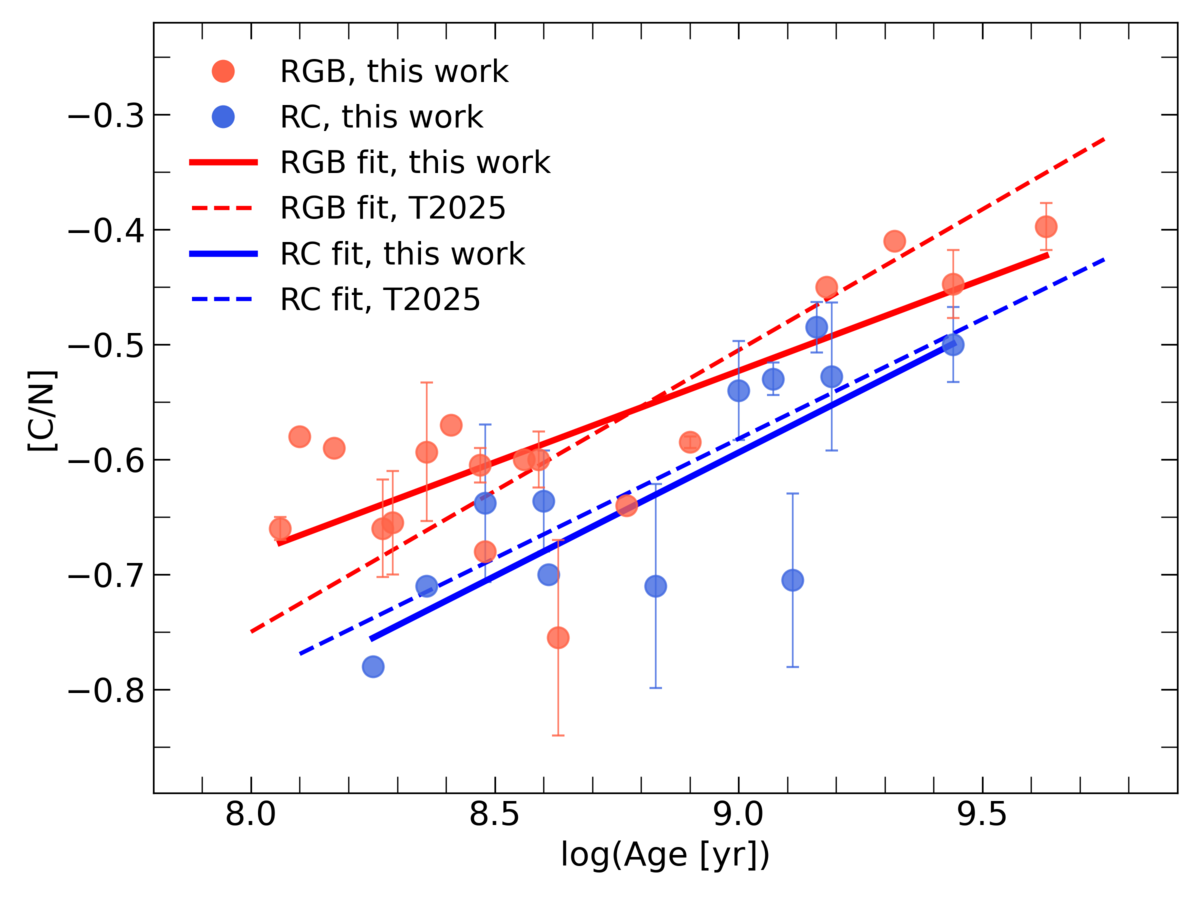
Our analysis indicate that precise age dating requires separate age calibrations of [C/N] ratios for the first-ascent giants of the lower part of red giant branch (RGB) and for the red clump (RC) stars (Fig. 1) to account for the additional carbon and nitrogen abundance alterations during the post-RGB luminosity bump evolution.