
Achieving isoform selectivity in carbonic anhydrase (CA) inhibition is a persistent hurdle in pharmacology, primarily due to the high structural conservation among the twelve catalytically active human CA isoforms. Carbonic anhydrases catalyze the reversible hydration of carbon dioxide to bicarbonate and protons. Their isoforms play roles in numerous physiological and pathological processes by regulating the pH and bicarbonate balance [1]. While CA II serves as the prototypical drug target for conditions like glaucoma and epilepsy, the CA I isoform frequently acts as an unintended off-target, leading to undesirable systemic side effects. To isolate and validate the molecular drivers of this specific selectivity, a protein engineering strategy was employed to create chCA I, a chimera built upon the CA II scaffold but containing CA I-specific active site residues. The aim was to assess whether these mutations alone are sufficient to switch the inhibitor recognition profile from CA II to CA I and analyze structural differences between CA I and CA II. The binding affinities of a focused set of sulfonamide-containing inhibitors were analyzed against human CA I, CA II, and the engineered chCA I. The binding constants (K\(_{b}\)) were determined using the fluorescent thermal shift assay (FTSA, also known as Thermofluor). This method allows for the precise quantification of ligand-induced thermal stabilization, which correlates directly with binding affinity [2]. Data processing and parameter calculation were performed using the online Thermott software (Thermott.com, Figure 1) [3]. Analysis of the thermodynamic parameters revealed that the introduction of CA I-specific active site mutations in CA II caused the chimeric protein to recognize sulfonamide inhibitors with affinities closely mirroring those of native CA I. Compounds that exhibited high affinity for CA I but low affinity for CA II bound to chCA I with high affinity, effectively "switching" the enzyme’s preference. The results demonstrate that a set of active site residues is sufficient to dictate the isoform-selective binding profile of CA I, since the chimeric CA I successfully mimics the ligand recognition properties of CA I. The characterized chCA I protein may therefore serve as a useful model for screening and designing highly CA I-selective inhibitors, potentially reducing off-target interactions in future therapeutic developments. 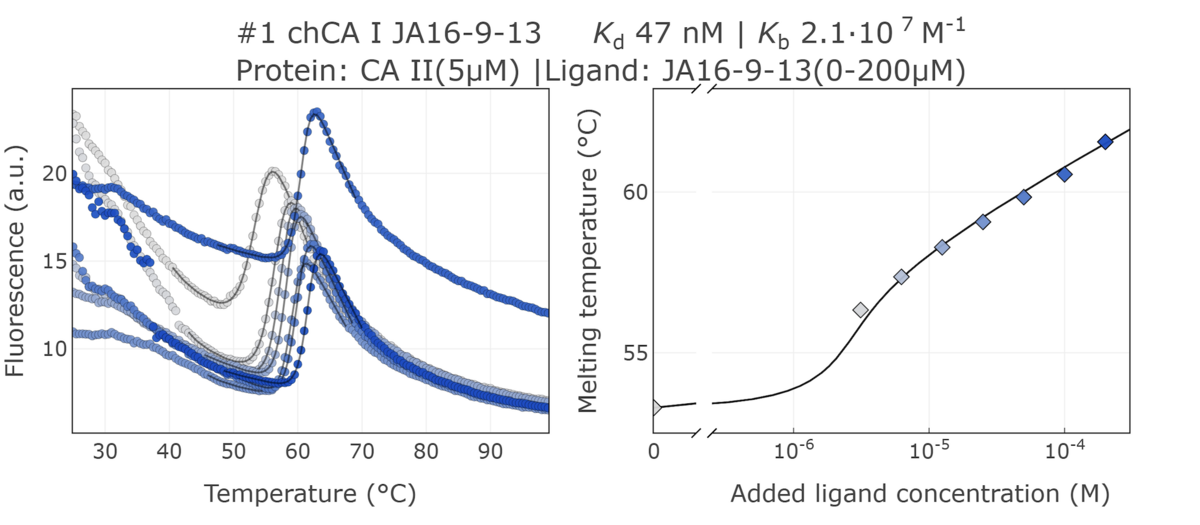
REPROGRAMMING INHIBITOR-ENZYME RECOGNITION PROFILE VIA CHIMERIC CARBONIC ANHYDRASE I
Ignas Glušnys1, Aurelija Mickevičiūtė1, Daumantas Matulis1, Joana Smirnovienė1
1 Vilnius University, Life Sciences Center, Institute of Biotechnology, Department of Biothermodynamics and Drug Design, Vilnius, Lithuania
[1] J. Smirnovienė et al., “Switching the Inhibitor‐Enzyme recognition profile via chimeric carbonic anhydrase XII,” ChemistryOpen, vol. 10, no. 5, pp. 567–580, May 2021, doi: 10.1002/open.202100042.
[2] V. Petrauskas, E. Kazlauskas, M. Gedgaudas, L. Baranauskienė, A. Zubrienė, and D. Matulis, “Thermal shift assay for protein–ligand dissociation constant determination,” TrAC Trends in Analytical Chemistry, vol. 170, p. 117417, Nov. 2023, doi: 10.1016/j.trac.2023.117417.
[3] M. Gedgaudas, D. Baronas, E. Kazlauskas, V. Petrauskas, and D. Matulis, “Thermott: A comprehensive online tool for protein–ligand binding constant determination,” Drug Discovery Today, vol. 27, no. 8, pp. 2076–2079, May 2022, doi: 10.1016/j.drudis.2022.05.008.