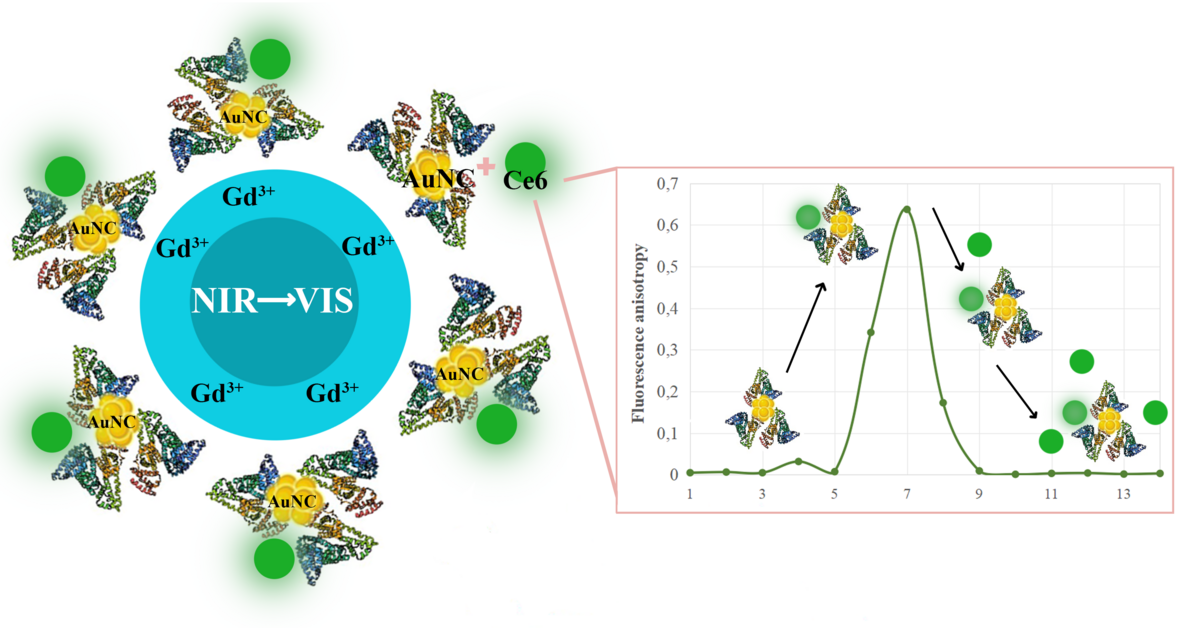
With photodynamic cancer therapy (PDT) being one of the clinically approved therapy strategies, its effectiveness greatly depends on the depth of the tumor and ability of light to reach photosensitizer that is accumulated in the tumor site. Near-infrared light (NIR) can penetrate deeper into tissues but lack energy to excite photosensitizers (PS). Upconverting nanoparticles (UCNPs) can offer a solution to this problem by converting NIR light in to higher energy VIS-UV photons, that are capable to excite PS molecules [1].
The goal of this study is to combine synthesized blood plasma protein gold nanoclusters (HSA-AuNC), PS Chlorin e6 (Ce6) and UCNPs to form complexes, that can be excited by NIR light, transfer energy to Ce6 and enable singlet oxygen generation. Gold nanoclusters were synthesized by reducing chloroauric acid in alkaline human blood serum environment [2]. The resulting HSA-AuNC were subsequently combined with Ce6 and UCNPs. The formation of the multicomponent complexes was confirmed using optical characterization techniques (Fig. 1). Energy transfer and singlet oxygen generation were investigated via photoluminescent decay, fluorescence anisotropy and singlet oxygen sensitive probes under VIS and NIR excitation conditions.
A red-shift of the Ce6 fluorescence emission and fluorescence anisotropy measurements confirms complex formation between Ce6 and HSA-AuNCs. Photoluminescence (PL) decay analysis reveals a pronounced shortening of the UCNP emission lifetimes in the UCNP–HSA-AuNC–Ce6 complex compared to free UCNPs, indicating efficient energy transfer from UCNPs acting as energy donors to Ce6 as the primary energy acceptor. Singlet oxygen generation, evaluated using fluorescence-based probe, under both VIS and NIR light demonstrates successful singlet oxygen generation.
Our investigations show promising potential for personalized therapeutic compounds, that can generate singlet oxygen, by being irradiated with deep-penetrating, low energy NIR light.