3D object reconstruction from 2D images is a widely used process in fields such as robotics, autonomous systems, cultural heritage digitization, and medicine. However, reconstructions based on point clouds (PC) often suffer from low density caused by poor texture or low-quality imaging, resulting in inaccurate and hole-filled surfaces. Therefore, this work focuses on surface reconstruction from point clouds using geometric methods, signed distance functions (SDF), and neural networks.
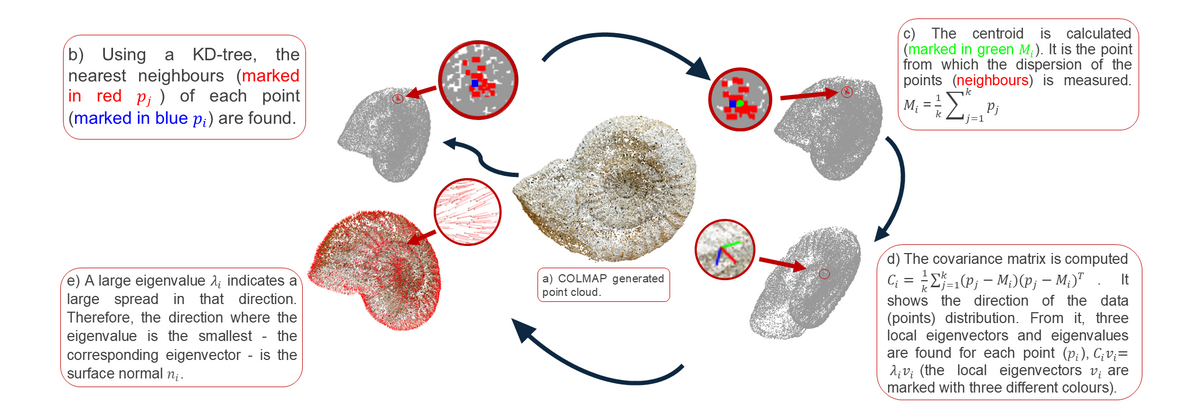
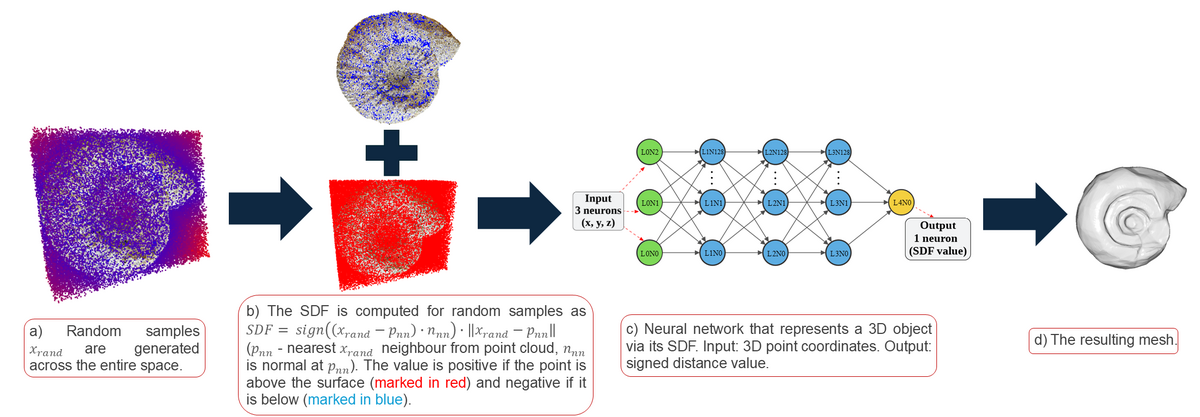
High-resolution (6000×4000 pix) ammonite images from Kaggle (dataset name: 3D OBJECT RECONSTRUCTION FROM IMAGES) were processed with COLMAP to generate a point cloud. Noise and non-surface points were removed using Python and CloudCompare to improve data quality and ensure effective neural network training. Surface geometry was analysed using K-dimensional tree (KD-tree) neighbours search, centroid calculation, and covariance matrix estimation. Eigenvalue and eigenvector analysis was applied to determine surface normals, where the smallest eigenvalue direction represents the normal vector. Random points were generated around and beyond the surface, and signed distance function (SDF) values were computed for all points. A neural network was trained to distinguish surface points from surrounding space, enabling accurate and continuous surface reconstruction.
Thus, by applying the method of this work, it is possible to attempt reconstruction of 3D surfaces even for less textured objects with sparse point clouds.