MOLECULARLY IMPRINTED CONDUCTIVE POLYMER PLATFORM FOR PROTEIN SENSING
Artem Yerniiazov1, Sarunas Zukauskas1, Alma Rucinskiene2, Arunas Ramanavicius1, 3
1 Center for Physical Sciences and Technology, Department of Nanotechnology, Lithuania, Vilnius.
2 Center for Physical Sciences and Technology, Department of Electrochemical Material Science, Vilnius, Lithuania.
3 Vilnius University, Faculty of Chemistry and Geoscience, Institute of Chemistry, Department of Physical Chemistry, Vilnius, Lithuania.
Molecularly imprinted polymer (MIP) platforms represent a low-cost and selective alternative to biosensors for protein sensing[1] in the 50–100 kDa range, such as bovine serum albumin (BSA). In this work, an overoxidized polypyrrole (PPy) nanofilm-based impedometric MIP fabricated on a glassy carbon electrode (GCE) is presented for the detection of BSA in the nanomolar range.
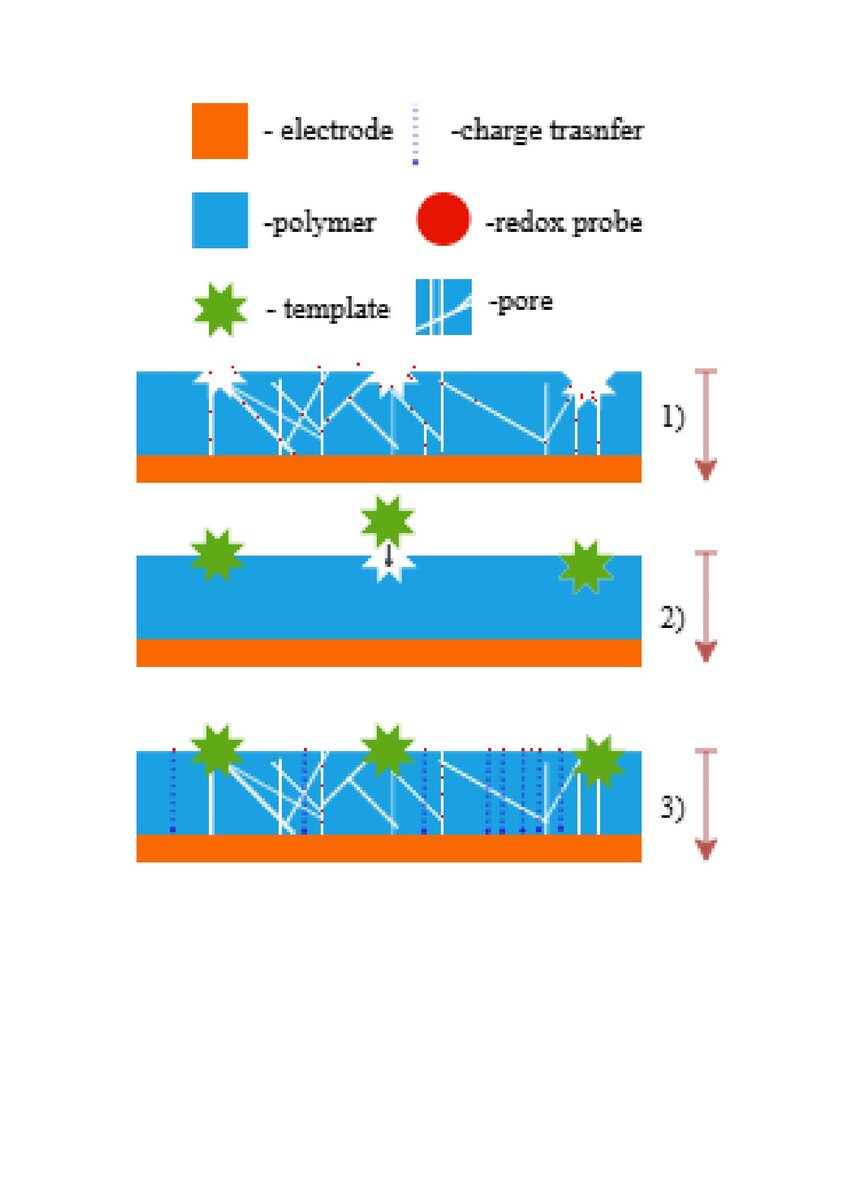
During MIP fabrication, chronoamperometric polymerization kinetically immobilizes the monomer–template complex by freezing the equilibrium between adsorption and desorption. After template extraction using protease, complementary cavities remain within the polymer matrix and function as specific binding sites during rebinding[2]. Electrochemical impedance spectroscopy (EIS) was employed as the primary transduction technique due to its minimal perturbation of the MIP layer. The sensing mechanism is primarily governed by changes in charge-transfer resistance (Rct) of the polymer by using a redox probe, the methodology schematics is in Fig.1. Capacitive sensing was additionally investigated under non-faradaic conditions in a low-ionic-strength electrolyte.
Analytical performance was evaluated using a concentration-dependent calibration curve[3]. In addition, binding kinetics studies revealed pseudo-first-order behavior, which is characteristic of nanofilm-based MIPs.
Fig. 1. Outer sphere charge transfer in a MIP. (1) The redox probe diffuses through open pores and transfers the charge to the electrode. (2) The analyte rebinding, obstructing the pores. (3) The charge transfer is through the conductive polymer to the underlying electrode.
[1] E. Mohsenzadeh et al., “Design of molecularly imprinted polymers (MIP) using computational methods: A review of strategies and approaches,” Wiley Interdisciplinary Reviews Computational Molecular Science, vol. 14, no. 3, May 2024, doi: 10.1002/wcms.1713.
[2] E. Mohsenzadeh et al., “Application of computational methods in the design of molecularly imprinted polymers (review),” TrAC Trends in Analytical Chemistry, vol. 171, p. 117480, Dec. 2023, doi: 10.1016/j.trac.2023.117480.
[3] G. Zvirzdine et al., “Electrochemical salicylic acid sensor based on molecularly imprinted polypyrrole,” ACS Applied Materials & Interfaces, vol. 17, no. 41, pp. 57475–57485, Oct. 2025, doi: 10.1021/acsami.5c11951.