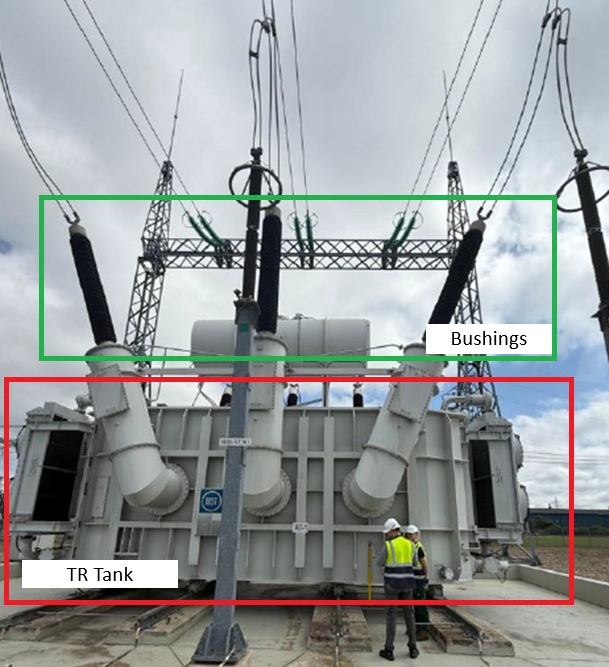
The high-voltage power transformer is a crucial component for transmitting electric energy in a region or country, active surveillance to avert unforeseen breakdowns is critical to guarantee a continuous power supply. The majority of transformer failures can be attributed to partial discharge (PD) in the insulation of a transformer [1]. Partial discharges are destructive events within a part of the insulation system which release energy that can have a destructive effect to a utility and any other utility connected to it. An increase of PD provides an early warning for gradual insulation degradation. However, in practical application, PD is only measured at the transformer’s bushings section which is applicable for on-line measuring but only provides partial data about the insulation quality of a transformer [2]. This paper presents a more detailed and reliable method of measuring and assessing on-line high voltage power transformer insulation quality using state-of-the-art acoustic and ultra high frequency (UHF) partial discharge detection. These measurements were done by applying acoustic emission and ultra high frequency sensors around 20 on-line 110-330 kV transformer tanks to measure, monitor and analyze local PD events. The research states that PD detection using aforementioned methods on the transformer tank were far more accurate for localizing a fault in an transformer. In addition, the suggested measuring method has saved time and resources due to the fact that a transformer disassembly was not required for this type of PD measuring. As a result, several cases were found where UHF and acoustic PD measuring was able to detect degrading insulation due to inner (transformer) and outer (other grid utilities) events. After all the measurements, to prove that this single outlier was not farce in detection of degrading insulation, a holistic assessment of the results was created. This was done by comparing acoustic and UHF PD measurements with provided PD voltage measurements of the bushings, the temperature and oil quality measurements of the transformers, it was possible to deduce the symptoms in order to confirm the diagnosis. This method has provided a way for substation engineers to better assess their transformer’s health and do so more frequently. For future research it is important to address and implement AI data processing algorithms due to the huge amount of PD measurement results. AI integration could save loads of work time and also provide an efficient way of monitoring transformer health.