Landfill leachate toxicity is influenced by various physicochemical and landfill-related parameters, how these factors shape biological responses and how toxicity changes under different landfill operational conditions remain poorly understood [1,2]. In this study, a biological assessment was conducted using Daphnia magna exposed to leachates collected from non-hazardous and industrial landfills differing in operational status (active or inactive), precipitation exposure (protected or unprotected), and treatment stage (untreated, partially treated, or fully treated).
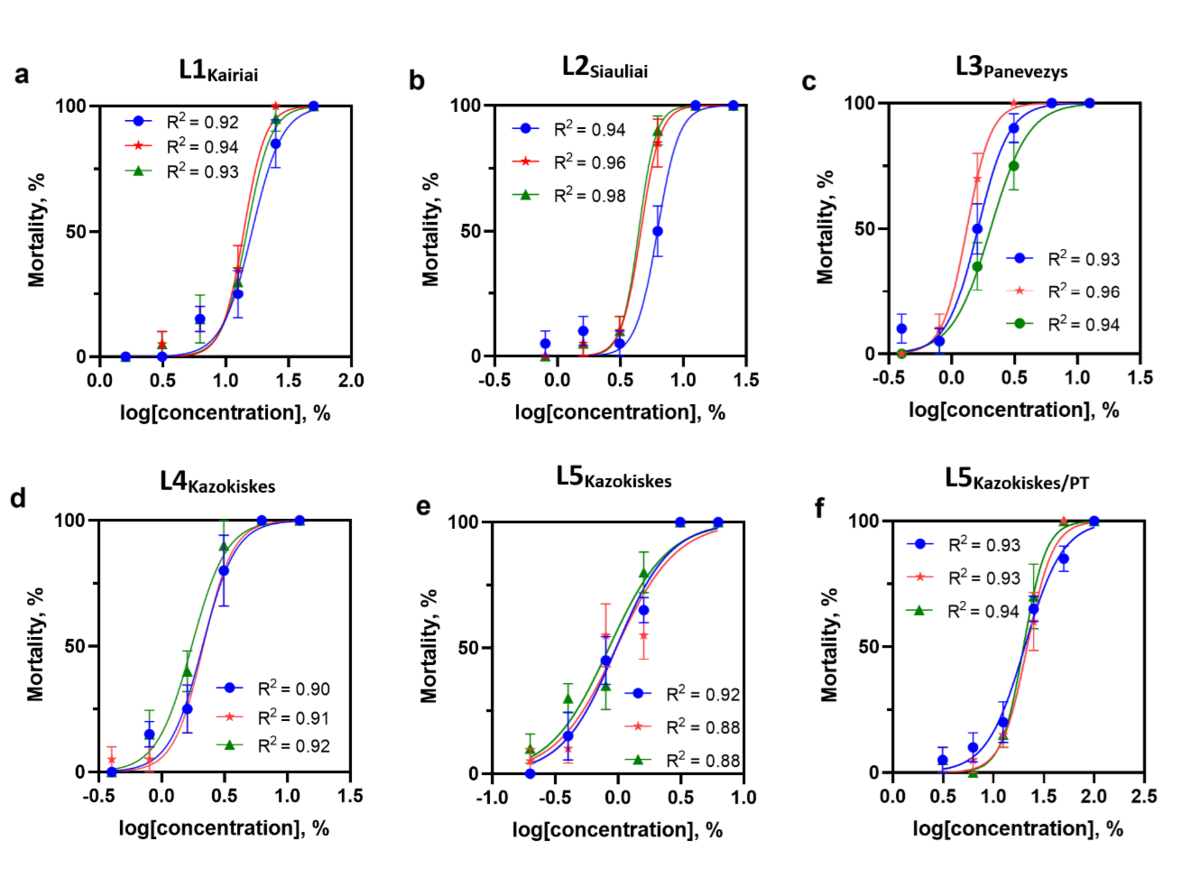
Acute effect concentrations (EC50) and low-effect equivalent concentrations (EC5 and its fractions: 1/4 and 1/16 EC5) were determined to enable comparisons among leachates and to link biological responses with physicochemical properties and landfill characteristics. This approach allowed the comparison of biologically equivalent exposure levels across sites and extended evaluation beyond standard endpoints by integrating biological responses.
Toxic effects were observed even at the lowest tested concentrations, including in treated leachates. Key physicochemical parameters driving leachate toxicity were identified, providing valuable insight for toxicity testing and environmental risk assessment. Based on toxicity unit (TU) values, the highest toxicity was observed in precipitation-protected leachate, followed by precipitation-unprotected leachates, leachate from non-operational landfills, and partially treated leachate after mechanical–biological treatment. No acute toxic effects were detected in fully treated leachate. At the individual level, locomotor activity was assessed after 4 and 7 days using average velocity, angular velocity, and acceleration. Clear dose–response patterns were observed: exposure to some untreated leachates increased activity, whereas the most contaminated leachates caused pronounced hypoactivity. Significant effects occurred at 1/4 EC5 and EC5 concentrations. In contrast, acceleration remained unaffected, indicating that baseline locomotor activity was a more sensitive indicator of sublethal stress than phototactic or startle responses.
In raw leachates, elevated concentrations of of Cl⁻, SO₄²⁻, NH₄⁺, K⁺, total Cr, COD, BOD, TOC, and EC were closely associated with landfill operational status, site size, waste volume, and precipitation influence. Among these, K⁺, TOC, COD, and EC showed the strongest associations with biological effects.
Overall, the results demonstrate that landfill age, waste composition, management practices, and treatment processes collectively determine leachate toxicity and associated biological responses. Further research is needed to elucidate contaminant interactions and assess the influence of landfill characteristics on long-term ecological risk.