The three-dimensional reconstruction of celestial bodies from two-dimensional image sequences is a critical capability for early mission characterization, enabling gravitational potential estimation and hazard detection before active sensors like LIDAR are operational. This research investigates the viability and accuracy of photogrammetric reconstruction using real archival data from the NASA OSIRIS-REx mission to asteroid (101955) Bennu.
The study adresses the specific challenges of space-based photogrammetry, including single-source harsh lighting, dynamic shadowing due to asteroid rotation, and the limitations of different mission phases. An automated pipeline was developed to process massive archival datasets, implementing a strict multi-stage filtering methodology to isolate photogrammetrically viable data. Out of approximately 26 000 approach phase archival images, only a fraction (<1%) were found suitable for Structure-from-Motion algorithms.
Comparative analysis of mission phases revealed that orbital sequences failed to generate coherent models due to insufficient image overlap and moving shadows. Conversely, the approach phase proved successful, as the combination of the spacecraft’s linear trajectory and the asteroid’s rotation created a "virtual orbit" effect with adequate baseline and consistent enough lighting.
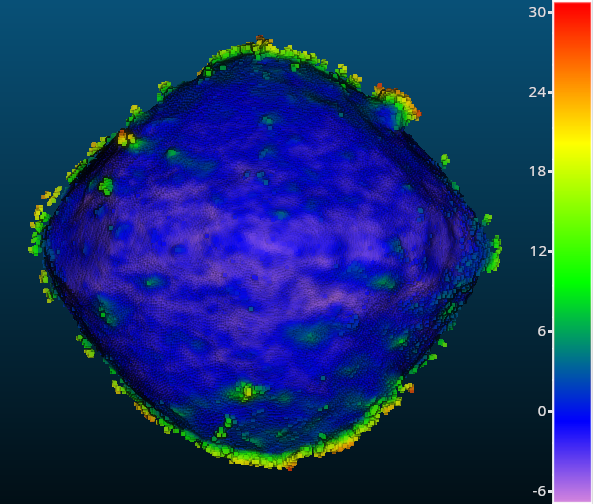
Quantitative validation against the ground-truth LIDAR model yielded a mean geometric error of \(\sim\)2 meters, representing approximately 0.4% of the asteroid’s diameter. The results indicate that while photogrammetry effectively captures the global volume and shape of the object, it acts as a geometric low-pass filter, smoothing out high-frequency topographic details. The study concludes that while optical reconstruction cannot replace high-precision LIDAR for tasks requiring sub-meter accuracy, it is a robust method for initial shape, volume and gravitational potential modeling during the approach phase of deep space missions.