
The advent of ultrafast solid-state laser sources emitting at around 2 µm, which are based on chromium-doped chalcogenides [1], as well as holmium and thulium doped lasing materials [2], fostered the development of optical parametric amplifiers (OPAs) which make use of novel non-oxide crystals, offering greatly improved quantum efficiency and favourable signal-to-idler photon energy ratio. To utilize the entire tuning range of 2 µm-pumped OPAs, broadband supercontinuum seed with spectral red shifts extending at least up to 4 μm is required. However, recent experiments performed in various nonlinear optical crystals (NOC) show that achieving spectral broadening to such extent is a difficult task [3,4]. In this Contribution, an investigation of supercontinuum generation with \(\sim\)2 µm driving pulses is presented in various dielectric and semiconductor bulk materials and a set material dispersion-related criteria are identified as a simple method of estimation of achievable red shifted spectral broadening.
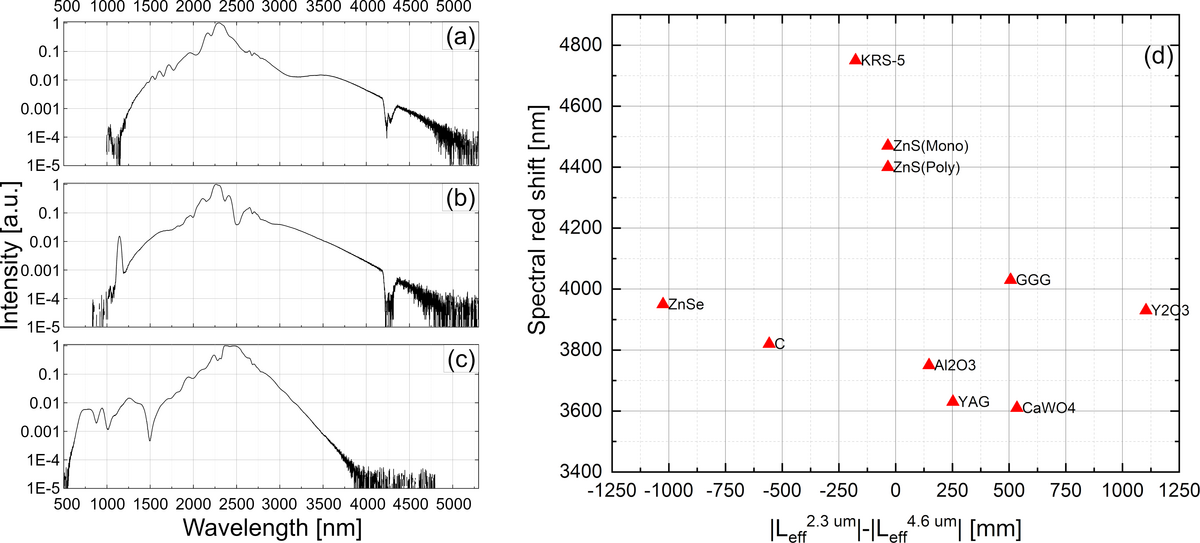
The experiments were performed with 180 fs, 2.3 µm driving pulses from an optical parametric amplifier. Supercontinuum generation was investigated in bulk nonlinear materials: KRS-5, ZnSe, ZnS (polycrystalline and single crystal), KGW, CaWO\(_{4}\), Diamond, Y\(_{2}\)O\(_{3}\), GGG, YAG and Sapphire. Material dispersion parameters: group velocity dispersion (GVD) and third-order dispersion (TOD), were analyzed as a potential limiting factor for supercontinuum spectral extent to the long-wavelength side. To fully investigate the influence of the dispersion parameters on supercontinuum spectral extent, materials that fall into both normal and anomalous GVD regimes were tested. Results show that for the tested central wavelength, NOCs that fall in the normal GVD range tend to produce larger spectral broadening to the long-wavelength side. The broadest red-shifted supercontinuum spectra were produced in ZnS and KRS-5 crystals, as shown in Fig.1(a) and Fig. 1(b), which are compared to typical supercontinuum spectrum generated in YAG, shown in Fig. 1(c). Additionally, larger spectral broadening to the long-wavelength side was achieved in materials with a low wavelength-dependence of the effective dispersion length, a parameter that incorporates both GVD and TOD, as summarized in Fig. 1(d).