In recent years, increasing attention has been paid to the development of sustainable and environmentally friendly materials to reduce the environmental impact of synthetic composites [1]. This study investigated the fabrication of hybrid composites using natural flax fiber and bio-based epoxy resin. Dynamic mechanical analysis (DMA) was performed to evaluate the mechanical properties of the composite. The experimental study was performed according to the ISO 6721 standard [2]. The composites were manufactured using an open-molding technique, ensuring uniform fiber distribution within the matrix and good interfacial adhesion between the composite components. For comparison purposes, a UV-curable resin was also used as a reference material and was tested under the same conditions.
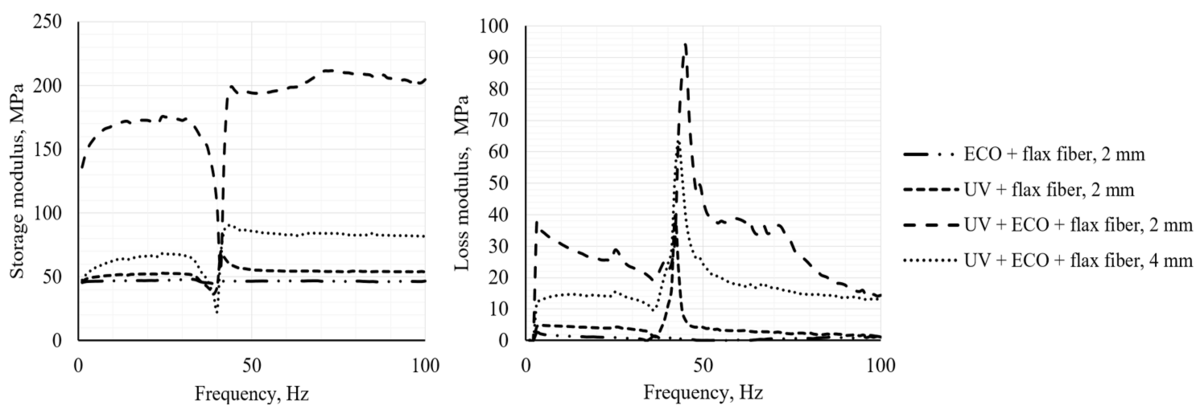
DMA tests were performed to evaluate the response of a material to cyclic mechanical load, since most materials today are subject to cyclic loading [3]. During the analysis, the storage modulus and loss modulus were determined, which allowed evaluation of the stiffness, elastic response, and internal energy dissipation of the composite. The results obtained showed that flax fiber reinforced composites exhibit different mechanical properties depending on the type of resin used. The highest stiffness, mechanical strength, and loss modulus values were determined for a hybrid composite consisting of flax fiber, bio-based epoxy resin, and UV-curable resin.
Although this hybrid composite exhibited good mechanical properties, at an excitation frequency of 40 Hz, the storage modulus decreased and the loss modulus increased. Considering the small dimensions of the tested specimens, changes in the storage and loss moduli were observed, which were not related to wave resonance phenomena but to internal relaxation processes and enhanced by interfacial interactions in the composite structure.