Chronic psychological stress is associated not only with psychiatric disorders but also with physical diseases. [1] Therefore, stress is increasingly recognised as a risk factor that may accelerate the development and progression of metabolic disorders, including type 2 diabetes mellitus (T2DM). [2] This chronic progression is closely related to lifestyle and environmental conditions. [3] However, limited data are available that directly link fatty acid (FA) composition to psychological stress in the context of T2DM. In this study, we investigated the effects of induced chronic psychological stress, using stroboscopic and water-avoidance stress models, on FA composition in a rat model of T2DM.
Levels of twenty-seven FAs were determined by gas chromatography–mass spectrometry. Fifteen of twenty-seven FAs were saturated fatty acids (SFA), six were monounsaturated fatty acids (MUFA), and six were polyunsaturated fatty acids (PUFA). Forty-eight adult male Wistar rats were used, and the study protocol was approved by the State Food and Veterinary Service (Approval No. B1-794). Rats were divided into five groups: control (n = 6), high-fat diet (HFD; n = 6), stress (n = 10), T2DM (n = 13), and T2DM + stress (n = 13).
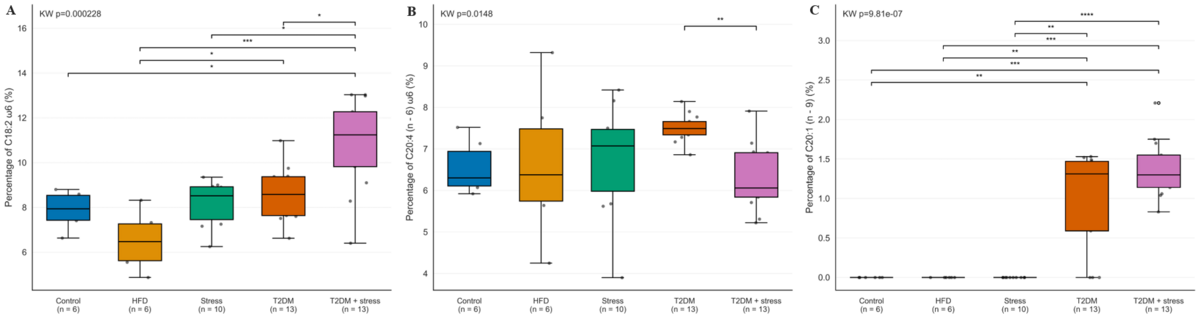
Significant differences in FA composition between the T2DM and T2DM + stress groups were observed in PUFA, particularly in the ω-6 FA fraction (Fig. 1, A and B). Additionally, the percentage of C20:1 (ω-9) FA differed significantly between the T2DM and T2DM + stress groups and the remaining experimental groups (Fig. 1, C). There were also group-specific changes in selected MUFA and PUFA fractions when compared with control and non-stressed groups.
These results suggest that chronic psychological stress modulates FA composition in rats with T2DM, with the most pronounced alterations observed in MUFA and PUFA, especially ω-6 FAs. This stress-related shift in FA profile may contribute to metabolic dysregulation in T2DM.