
Lithium (Li), together with the surface abundances of carbon, nitrogen, and oxygen (CNO), is considered a sensitive diagnostic of stellar evolution and internal mixing processes. In single red giant stars, the evolution of these abundances is generally well reproduced by standard stellar evolution models after the first dredge-up has occurred. In contrast, RS CVn-type binaries are recognized as a distinct class of close, chromospherically active systems characterized by rapid rotation and strong magnetic activity, and chemical abundance patterns that depart from classical evolutionary predictions are frequently exhibited.
In this study, Li and CNO abundances, as well as the \(^{12}\)C/\(^{13}\)C and C/N ratios, are investigated in a sample of 33 RS CVn stars observed with the 1.65,m Moletai Astronomical Observatory telescope using the VUES spectrograph. These data are complemented by archival high-resolution spectra of 13 additional RS CVn stars obtained in previous analyses. Chemical abundances are determined through spectral synthesis, and stellar masses are estimated using the UniDAM tool.
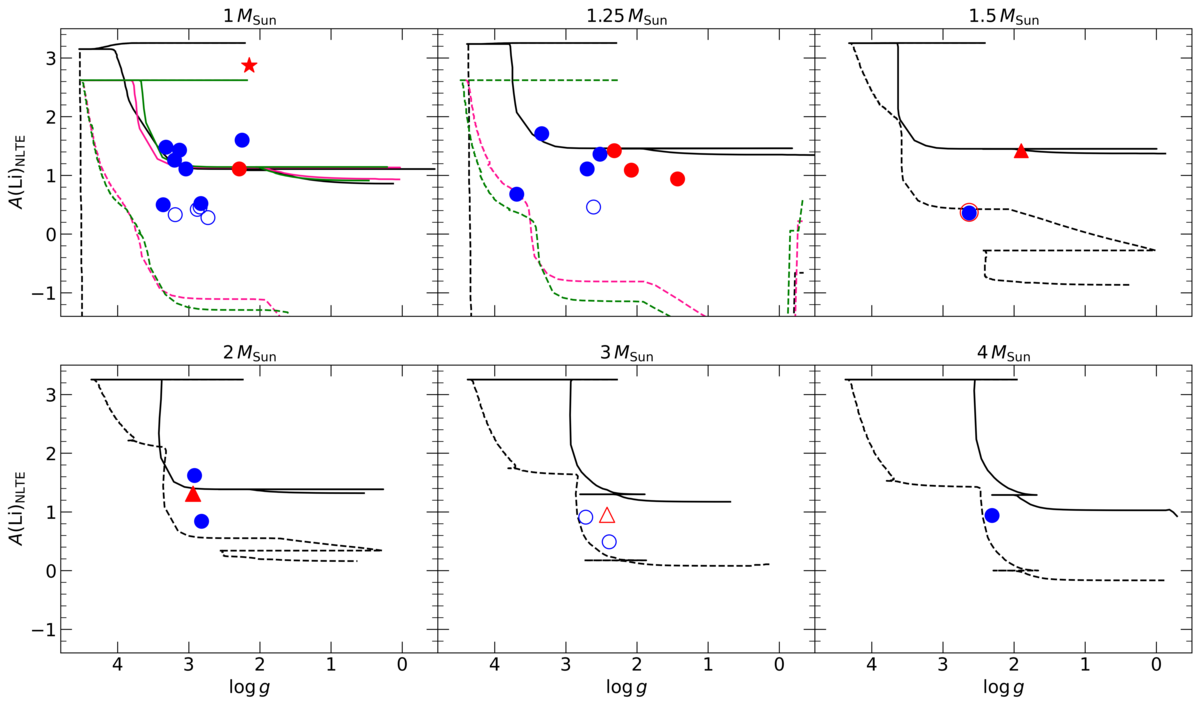
It is found that approximately half of the low-mass RS CVn giants exhibit lithium abundances consistent with predictions for the first dredge-up, whereas significantly enhanced Li depletion is observed in the remaining stars as seen in Figure 1, indicating that additional mixing processes, most likely thermohaline mixing, are operating. In intermediate-mass RS CVn stars, lithium abundances are found to be systematically lower than those predicted by standard stellar evolution models, with rotation-induced mixing considered the most plausible explanation. Overall, the lithium evolution observed in RS CVn systems is broadly consistent with the declining trend seen in normal red giants, although an earlier onset and increased efficiency of extra mixing processes are suggested.
Carbon isotopic ratios provide further support for this interpretation. Low \(^{12}\)C/\(^{13}\)C ratios are exhibited by two stars, \(\iota\) Gem and HD 179094, despite their location below the red giant branch luminosity bump, implying that extra mixing may be initiated earlier in magnetically active stars than in inactive counterparts. In contrast, unusually high C/N and \(^{12}\)C/\(^{13}\)C ratios are retained by the Li-rich giant V* OP And, and the physical mechanism responsible for its lithium enrichment remains unresolved.