
Diamond nanoparticles, or nanodiamonds (NDs), are perfectly suitable for nanomedicine due to the outstanding properties: exceptional biocompatibility, high carrying capacity, and a wide array of surface functional groups [1]. Studies in which NDs were used as delivery platforms for anthracyclines reveal that, compared to the efficacy of anthracyclines alone, ND-drug complexes substantially increase tumor-killing efficacy even in highly drug-resistant cases [2, 3].
One of the drawbacks of treating cancer with the help of NDs is the difficulty to track their localization and movement in vivo. Luckily, studies show that Overhauser effect-enhanced magnetic resonance imaging can in principle be used to monitor and track NDs in vivo [4]. Since this technology is based on the spin polarization transfer from unpaired electrons in NDs to protons in water hydrogen atoms, it is crucial for water molecules to be positioned as close as possible to the unpaired electrons at the ND surface. Theoretically, this can be examined by the first-principles calculations which determine whether paramagnetic defects with unpaired electrons can act as water attraction centers. It is also important to assess how the position of paramagnetic defect in ND and the functionalization of ND surface influence the interaction process.
In this work, water interactions with the dangling bonds (DBs) at the surface of NDs were modelled using semiempirical tight-binding GFN2-xTB [5] method via the automated DOCKER algorithm available in the ORCA quantum chemistry package [6]. The ND used in calculations was C35, which has 3 unique DB states at its surface. Two surface functionalizations were chosen – hydrogenation and hydroxylation. Overall, it was revealed that water prefers to interact with DBs at the hydrogenated surface, while in case of hydroxylation water tends to form bonds elsewhere.
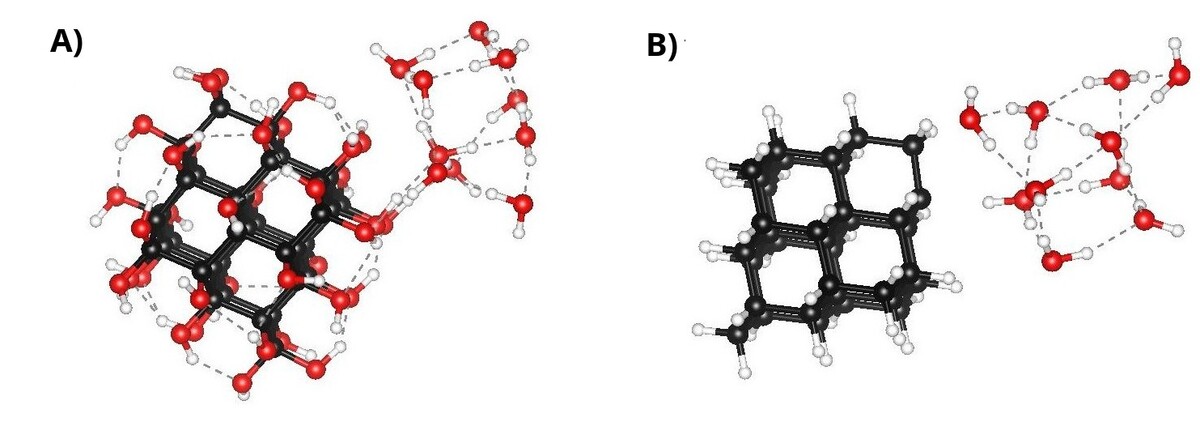
Figure B) ND with H-functionalized surface interacting with water