Most quantum-mechanical systems interact with some kind of environment consisting of a large number of degrees of freedom. Such interactions between an open quantum system and its environment lead to damping, dissipation and strong decoherence [1]. The theory of open quantum systems is widely used in almost all areas of physics, including quantum optics, spectroscopy, chemical physics and quantum information [2]. The dynamics of such systems can be described by the so-called quantum master equation [3], which is usually obtained by employing projection superoperators.
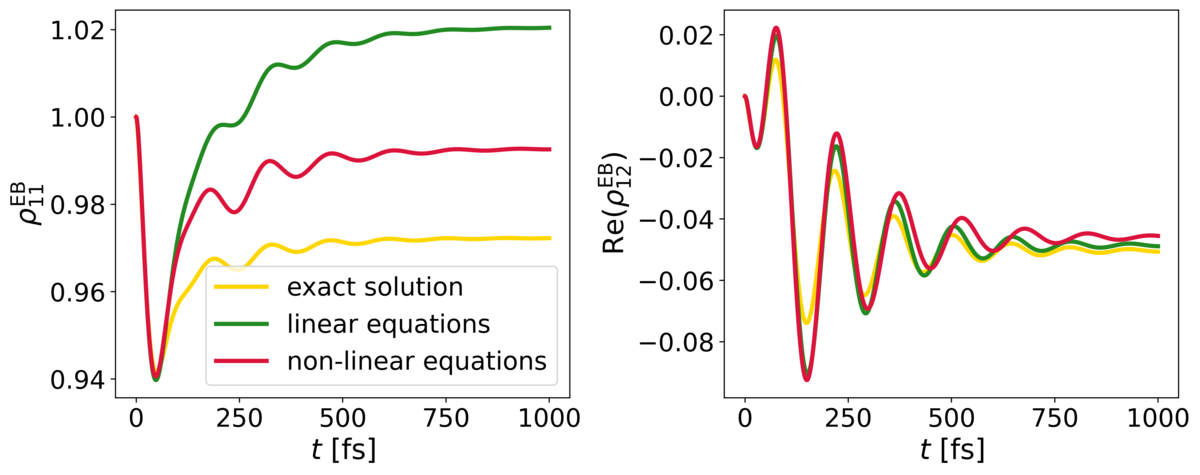
In this work, we used a time-dependent projection superoperator proposed in Ref. [6] to derive quantum master equations for a molecular system and compare the results with the exact numerical solutions as well as with those obtained from the standard quantum master equation. It was found that the resulting equations are non-linear and differ from those obtained using a time-independent projector only by non-linear terms. We analyzed the obtained results for a variety of parameter values for a two-level molecular system. Fig. 1 shows an example comparing the exact solution and the solutions obtained from the linear and non-linear equations for the elements of the density operator at low temperature. It can be seen that the linear equations yield unphysical population values outside the range [0,1], while this issue does not arise for the non-linear equations. This represents a clear advantage of the time-dependent projector.
On the other hand, at high temperatures and for small values of the reorganization energy, both linear and non-linear equations yield excellent accuracy. For larger reorganization energies, however, the accuracy decreases significantly, with no noticeable difference between the linear and non-linear equations. In the fast bath relaxation regime, both linear and non-linear equations also produce accurate results.