RAPID FEMTOSECOND-LASER FABRICATION OF A PLASMONIC SENSOR FOR GLYCEROL DETECTION
Kernius Vilkevičius1, Tomas Rakickas2, Evaldas Stankevičius1
1 Center for Physical Sciences and Technology, Department of Laser Technologies, Savanoriu Ave. 231, Lithuania
2 Center for Physical Sciences and Technology, Department of Nanoengineering, Savanoriu Ave. 231, Lithuania
Plasmonic nanostructures and their gratings attract a high interest due to their interactions with light at the nanoscale. Fast and repeatable fabrication of such structures is critical for practical applications and scalable mass production. While conventional lithographic or chemical techniques offer either high precision or simplicity, they are often limited in scalability, throughput, or repeatability. A proposed direct laser writing (DLW) [1] employing single femtosecond pulses for plasmonic array formation offers single-step fabrication with both high accuracy and reproducibility. Periodically arranged gold nanostructures’ interaction with radiation results in the enhancement of local electromagnetic field and increased absorption at the resonant wavelengths. These phenomena are exploited in surface-enhanced Raman spectroscopy (SERS) and plasmonic sensing [2], therefore, the tunability of the produced structure properties are of high interest.
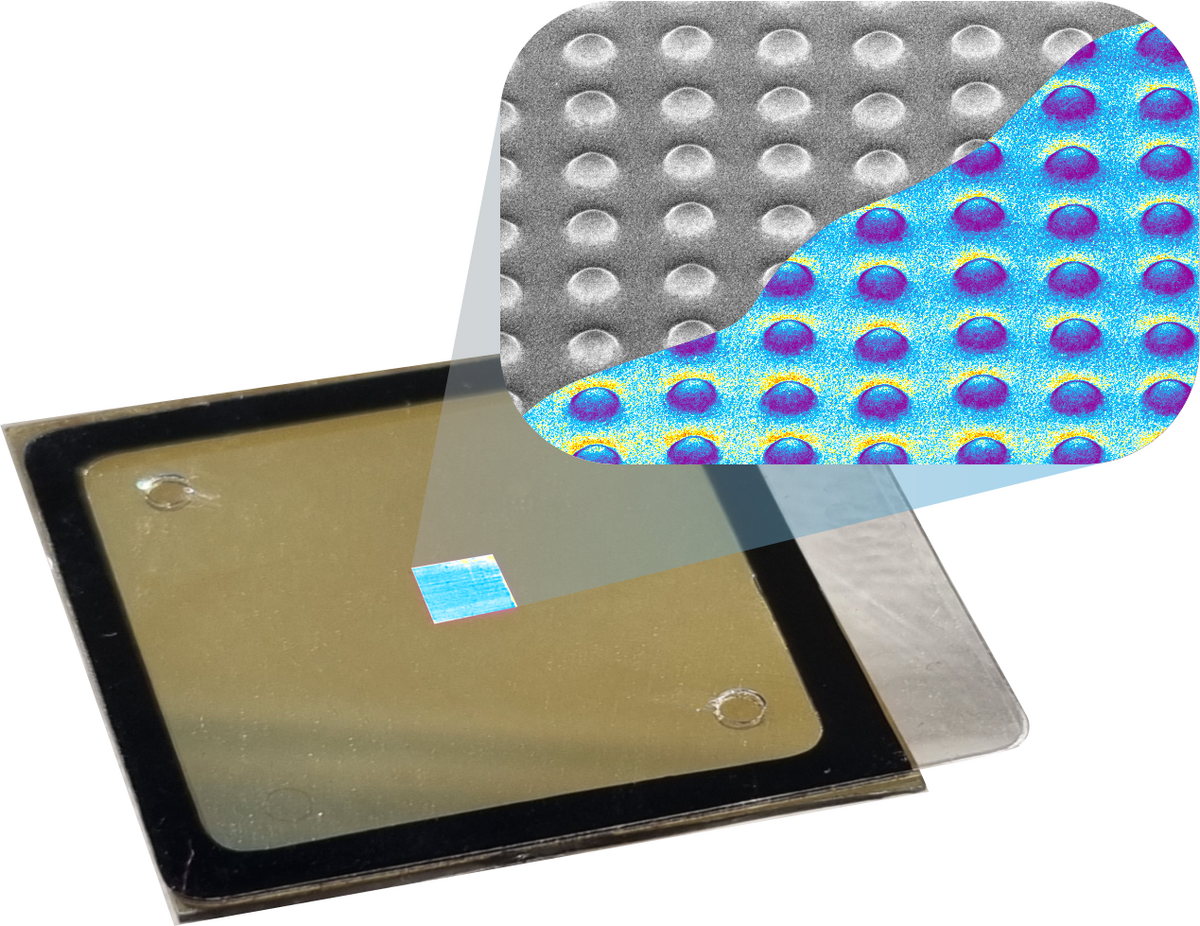
Fig. 1. Ag-Au nanobump sensing platform
Periodic plasmonic nanostructures on 50 nm thick gold, silver, and silver-gold bilayer films were fabricated by DLW using 343 nm femtosecond pulses. Changes in pulse energy impact the resulting morphology of the structure, thereby influencing the excitation and coupling of plasmonic modes [3]. While already effectively applied in SERS [4], such metallic arrays can also be used in sensing measurements. The optical response of the fabricated samples was characterized using spectroscopic techniques, revealing strong sensitivity to changes in the surrounding refractive index (RI), as the resonance shifts can be observed at various solutions to determine their concentration. Hemispherical bumps provide the sharpest resonant peaks and demonstrate remarkable peak redshift with increasing liquid RI, reaching a sensitivity of around 800 nm/RIU [5]. Individual resonant modes of both s- and p-polarizations have distinct sensitivities to glycerol solutions, with the most prominent response being for the out-of-plane origin resonance. By optimizing the angle of incidence, the sensing platform performance is further improved, reaching sensitivities of up to 933 nm/RIU and a figure of merit parameter of 57 RIU\(^{-1}\). Such single-metal and bilayer nanobump platforms demonstrate excellent stability, repeatability, and durability, maintaining their optical properties for over six months, marking a potential for reliable and long-term accurate measurements.
The authors acknowledge the Research Council of Lithuania (LMTLT) for the received funding under project No. S-TPP-23-14.
[1] E. Stankevičius, K. Vilkevičius, M. Gedvilas, E. Bužavaitė‐Vertelienė, A. Selskis, and Z. Balevičius, “Direct laser writing for the formation of Large‐Scale gold microbumps arrays generating hybrid lattice plasmon polaritons in VIS–NIR range,” Advanced Optical Materials, vol. 9, no. 12, Apr. 2021, doi: 10.1002/adom.202100027.
[2] K. Yang, X. Yao, B. Liu, and B. Ren, “Metallic Plasmonic Array Structures: Principles, fabrications, properties, and Applications,” Advanced Materials, vol. 33, no. 50, May 2021, doi: 10.1002/adma.202007988.
[3] K. Vilkevičius, G. D. Tsibidis, A. Selskis, E. Stratakis, and E. Stankevičius, “Formation of highly tunable periodic plasmonic structures on gold films using direct laser writing,” Advanced Optical Materials, vol. 12, no. 20, Apr. 2024, doi: 10.1002/adom.202400172.
[4] K. Vilkevičius, I. Ignatjev, A. Selskis, G. Niaura, and E. Stankevičius, “Tuning SERS performance through the laser-induced morphology changes of gold nanostructures,” Applied Surface Science, vol. 660, p. 160003, Mar. 2024, doi: 10.1016/j.apsusc.2024.160003.
[5] K. Vilkevičius, T. Rakickas, and E. Stankevičius, “High‐Quality Plasmonic Ag─Au Bilayer Nanobump Grating Sensor,” Advanced Materials Technologies, vol. 10, no. 20, Aug. 2025, doi: 10.1002/admt.202501199.