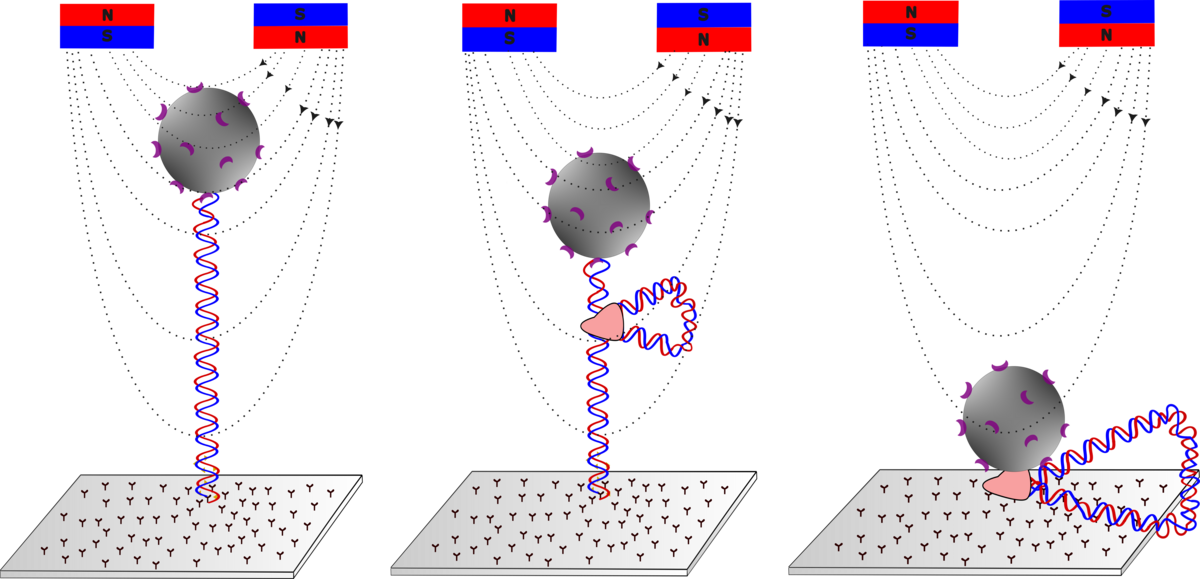
Restriction–endonuclease (RE) enzymes play a key role in the bacterial defense against foreign DNA invasion. NgoAVII is a type I RE enzyme composed of the restriction subunit with PLD nuclease and B3-like DNA-binding domains, and the helicase-like subunit, containing DEAD-box and Z1 domains.
Unlike traditional RE systems, it not only cuts the DNA but also translocates on the dsDNA using ATP. The translocation dynamics of NgoAVII is not fully understood, particularly how it is coordinated with DNA sequence recognition and cutting. To investigate the translocation, we use a custom-built magnetic tweezers microscope to study it at single-molecule level. We find that the translocation occurs via looping and unlooping events. We further investigate how translocation depends on force and the interaction between restriction and translocation subunits. We anticipate that the mechanical properties obtained in this study will provide valuable insight into the mechanisms of type I RE systems.