Multi photon polymerization (MPL) features a maskless 3D printing method, that enables complex 3D design fabrication with feature sizes below 1 µm using femtosecond laser radiation [1]. As a manufacturing tool, MPL offers unmatched versatility and great adaptability for realizing advanced optical components on surfaces that are hard to access, such as optical fibers. This capability presents significant opportunities for developing optical applications in integrated optical scenarios [2].
Within the field of advances of optical components, metasurfaces – comprising individual nanostructures arranged in carefully designed patterns – have attracted considerable interest. These planar elements are often regarded as flat analogues of conventional optical components and enable precise tailoring of electromagnetic waves, fostering compact devices for precise light manipulation [3].
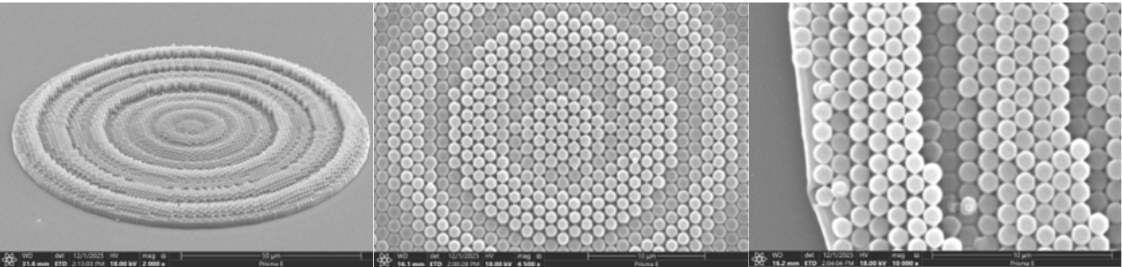
This work demonstrates the fabrication of metasurfaces operating at telecommunication wavelengths, with a specific focus on metalenses composed of isotropic unit cells formed by cylindrical nanorods, fabricated using MPL and organic-inorganic photoresists. Alongside the metalens design, its optical properties were simulated by finite-difference time-domain (FDTD) methods. For the fabrication of MPL, the metalens design was sliced into individual layers and hatched with defined spacing to generate the exposure paths for the laser radiation. The fabricated metalens exhibited high structural fidelity, with nanorod diameters of 0.6 µm (see Fig. 1). Structural characterization was performed using scanning electron microscopy. These results highlight the strong potential of MPL as a maskless fabrication approach for further exploring multi-layer metasurfaces with more complex unit cell geometry.