1 Vilnius University, Faculty of Physics, Institute of photonics and nanotechnology, Vilnius, Lithuania
2 Vilnius university, Faculty of Chemistry and Geosciences, Institute of chemistry, Vilnius, Lithuania
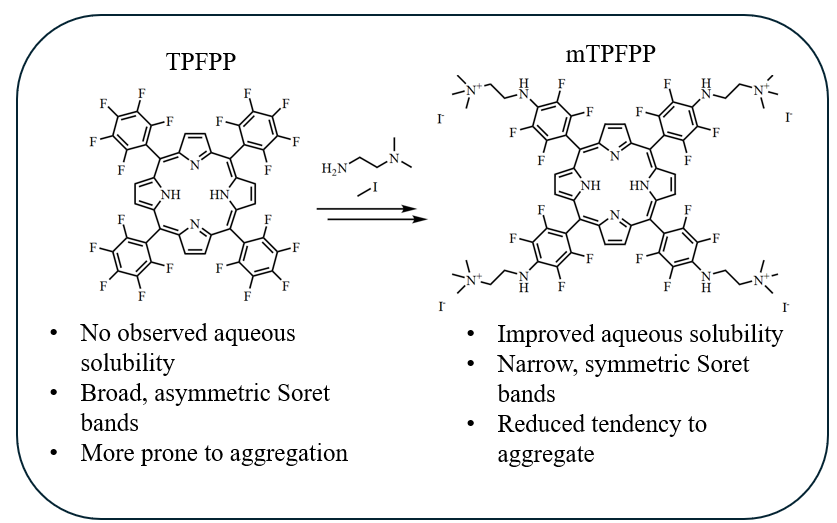
Porphyrins are widely studied as photosensitizers due to their high singlet oxygen quantum yield and broad absorption range, with a strong absorption band near 400 nm called the Soret band. However, their practical use is often limited by poor solubility and a strong tendency to aggregate in aqueous solutions, which leads to spectral changes, decreased absorbance and fluorescence intensity [1]. Chemical modification of the porphyrin structure, particularly the introduction of cationic substituents, is a common strategy to improve solubility and reduce aggregation [2]. The aim of this study is to investigate the photophysical properties of neutral tetrakis (pentafluorophenyl)porphyrin (TPFPP) and its cationic derivative (mTPFPP) (Fig. 1) in aqueous media.
Fig. 1. Molecular structures of the parent porphyrin TPFPP and the modified cationic mTPFPP with quaternary ammonium substituents.
Preliminary visual observations showed that TPFPP is insoluble in distilled water (dH₂O) and phosphate-buffered saline (PBS), whereas mTPFPP exhibits partial solubility in dH₂O and good solubility in PBS. Due to the limited water solubility, stock solutions of both compounds were prepared in dimethyl sulfoxide (DMSO) and subsequently diluted into dH\(_{2}\)O and PBS to obtain working concentrations. UV–Vis absorption and fluorescence spectroscopy were used to examine their spectral features and concentration-dependent behavior in both media, while aggregation effects were further assessed by the addition of a non-ionic surfactant, Triton X-100. In dH\(_{2}\)O TPFPP exhibited broad and asymmetric Soret bands with varying position and shape, indicating aggregation effects. In contrast, mTPFPP showed narrower, symmetric Soret bands that remained constant, together with higher absorbance and fluorescence intensities. In PBS the same tendency was observed but with greater spectral broadening and lower absorbance and fluorescence intensities for both porphyrins, implying stronger tendency to aggregate than in dH\(_{2}\)O. The addition of the non-ionic surfactant Triton X-100 increased fluorescence intensity for both compounds and narrowed the Soret bands of TPFPP, indicating partial disaggregation.
These results suggest that cationic modification is associated with improved solubility and greater spectral stability of TPFPP in aqueous media.
[1] A. Glowacka-Sobotta et al., “Versatile Porphyrin Arrangements for Photodynamic Therapy—A Review,” Nanomaterials, vol. 14, no. 23, p. 1879, Nov. 2024.
[2] M. Luciano and C. Brückner, “Modifications of porphyrins and hydroporphyrins for their solubilization in aqueous media,” Molecules, vol. 22, no. 6, p. 980, Jun. 2017.