Terahertz (THz) radiation has attracted increasing interest for biomedical imaging and spectroscopy applications, as it can penetrate dielectric materials opaque to visible light while remaining non-ionizing. Its low photon energy enables safe in vivo skin studies, where strong water sensitivity can provide contrast between healthy and cancerous tissue [1]. When modeling skin tissue across a broad THz range, scattering is often neglected due to strong water absorption. However, tissue structures with dimensions comparable to the wavelength can produce Mie scattering effects that should be considered to improve diagnostic accuracy.
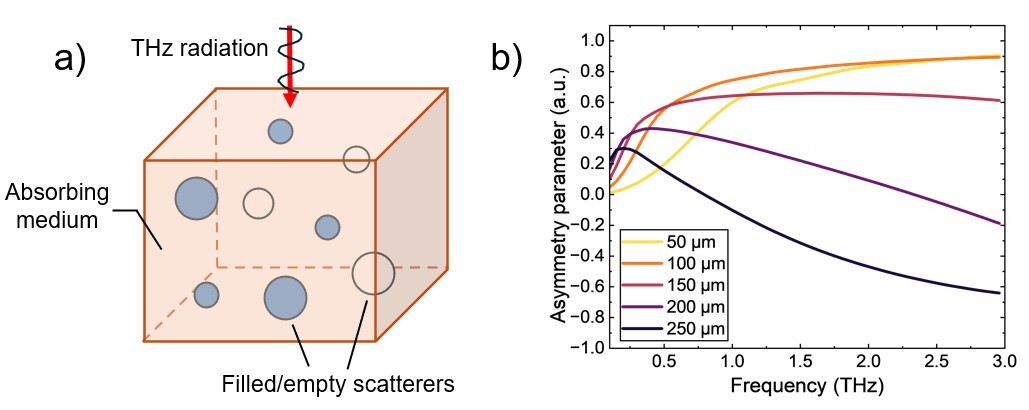
To analyze light scattering, spherical scatterers with radii of 50–250 µm (size parameter x ≈ 1–15 across 0.1–3 THz) were modeled using Mie theory modified for an absorbing host medium [2]. Both high and low refractive-index contrast cases were examined, corresponding to empty and filled sweat glands in dermis medium, respectively (Fig. 1a). A three-layer skin model, including stratum corneum, epidermis and dermis (layer thicknesses of 30 µm, 100 µm, and 1 mm, respectively) was also simulated using the discrete dipole approximation (DDA), adapted for irregular structures inserted inside the multilayered medium [3]. Layer permittivities were calculated using effective dielectric function of mixtures [4], based on double-Debye permittivities derived from THz spectroscopy data reported in the literature.
For the low refractive-index contrast case between filled sweat glands and dermis, the scattering asymmetry parameter became negative with radii >150 µm, reaching -0.65 at 3 THz (Fig. 1b), indicating enhanced backscattering at higher frequencies, whereas high-contrast case remained positive. In the multilayer skin model, a prolate ellipsoid representing basal-cell carcinoma (BCC) structure was inserted across all three layers, producing only a small reflectivity increase of ≈0.13 % when its surface area was increased from 0.21 mm\(^2\) to 0.28 mm\(^2\). Varying structure depth showed that beyond 200 µm backscattering contributed negligibly to the overall reflectivity due to strong THz absorption by water. In this case, calculated reflectivity was dominated by interface reflections rather than intrinsic scattering.
In conclusion, while larger structures increased THz scattering, its contribution to the total reflectivity in the multilayer skin model became negligible for deeper layers due to strong water absorption and interface reflections, highlighting the need for high-sensitivity detection and polarization-resolved approaches to detect weak scattering signals.