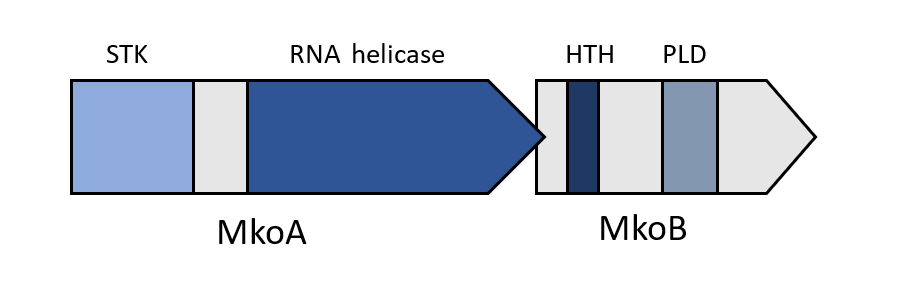
During the constant battle between bacteria and bacteriophages, bacteria have evolved a plethora of anti-phage defense systems. While restriction-modification, and CRISPR-Cas systems have been characterized to various extents, there remain completely uncharacterized and novel anti-phage defense systems. One of these systems, named after the Slavic goddess, protector of women’s destiny, Mokosh, is a family of defense systems that is evolutionarily linked to eukaryotic immune system proteins, more specifically anti-transposon piwi-interacting RNA pathway proteins [1]. The Mokosh type I system is one of two in the Mokosh family and contains two proteins MkoA and MkoB, which contain four predicted domains (STK, RNA helicase, HTH, PLD, fig. 1) [2].
The primary aim of this study is to examine the specifics of each domain and its function. Here we present our findings on the Mokosh type I defense system, focusing mostly on in vitro experiments. Firstly, we optimized the expression of the proteins MkoA and MkoB in E. coli using different strains. Additionally, after successfully purifying both proteins together, two mutants were selected and purified as well. Subsequently, we tested different nucleic acid substrates using denaturing urea polyacrylamide gel electrophoresis, possible inhibitory mechanisms and nucleotide hydrolysis with microplate assays, as well as identifying possible oligomerization states using mass photometry and SEC-MALS.
This research unveils a new potential tool for biotechnology and could provide new insights into the evolution of eukaryotic immune system proteins. Our gathered data serves as a valuable first step in understanding the Mokosh type I anti-phage system and its mechanisms of action.