InGaAs is a well-studied III–V ternary semiconductor with a tunable bandgap suitable for near-infrared (NIR) applications. Decades of progress in epitaxial growth have made it a reliable platform for systematic studies of barrier effects on optical properties of quantum wells (QW). In this work, we investigate the influence of graded AlGaAs barrier profiles on the emission of InGaAs QW structures, motivated by earlier reports of enhanced carrier capture and photoluminescence (PL) intensity in graded-index separate-confinement heterostructures [1,2].
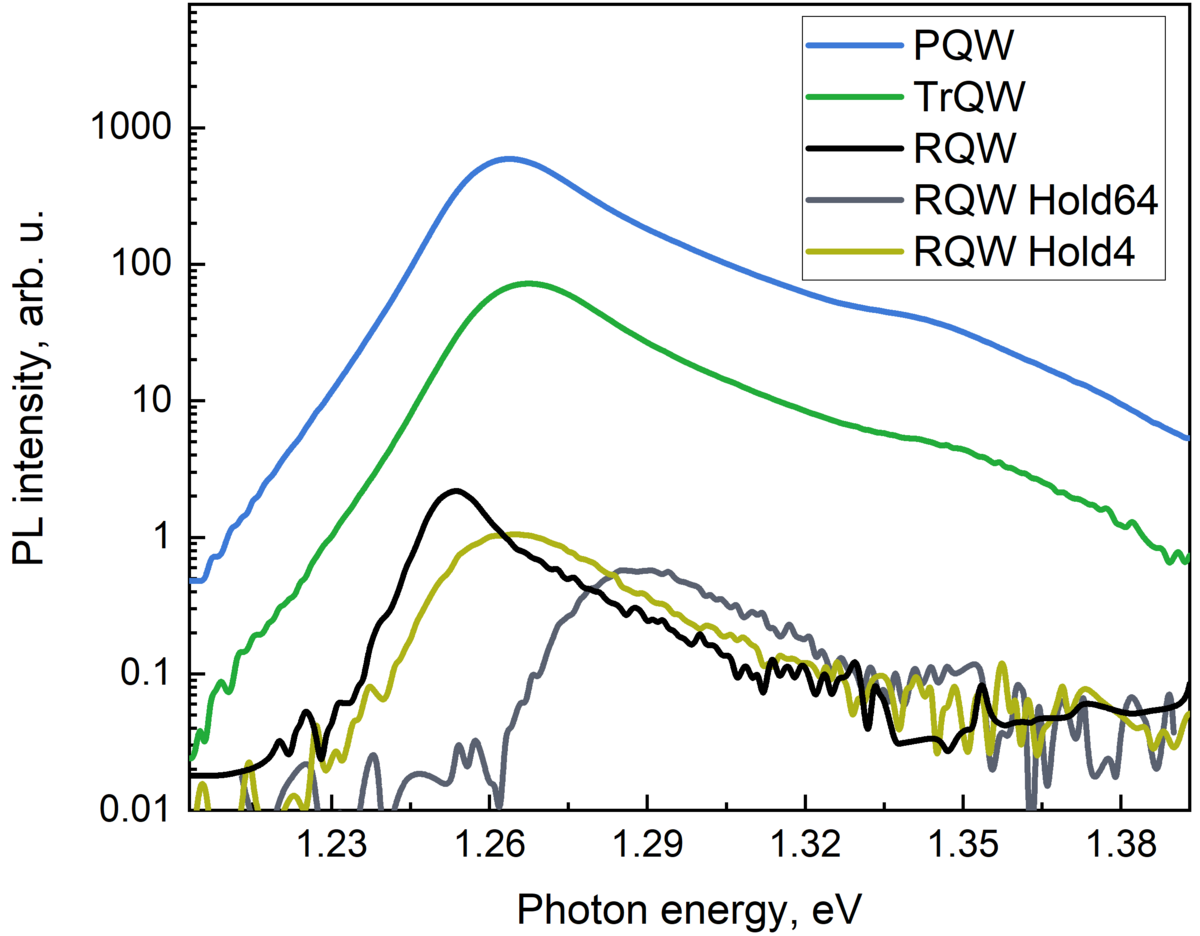
The InGaAs QW samples were grown by molecular beam epitaxy on semi-insulating GaAs (100) substrates. Investigated structures include parabolically graded (PQW) and linearly graded (TrQW) AlGaAs barriers, with Al composition varying from 30% to 0%. Additional rectangular quantum well (RQW) samples with prolonged in-situ annealing were grown to separate effects of barrier design from high-temperature exposure. Optical properties were studied using temperature-dependent PL, supported by band-structure simulations performed with Nextnano. Room-temperature PL measurements reveal a clear enhancement of emission intensity in structures with graded AlGaAs barriers relative to conventional RQWs (see Fig. 1).
Temperature-dependent PL shows improved carrier confinement and suppressed thermal quenching in graded-barrier designs, with PQW structures exhibiting the highest PL intensity up to 300 K. Analysis of PL peak energies indicates moderate blueshifts associated with high-temperature exposure, attributed to In segregation, while simulations confirm higher In retention in the presence of Al-containing barriers. Arrhenius analysis of PL intensities identifies higher activation energies for nonradiative processes in graded-barrier structures, consistent with enhanced carrier trapping.