
Lead-based halide perovskite solar cells (PSCs) have gained significant attention due to their rapid performance advancements, with certified power conversion efficiencies (PCE) now reaching up to 27.3%, making them comparable to silicon solar cells. Recently, a perovskite/silicon tandem solar cell efficiency of 35.0% was reported, which exceeds the theoretical efficiency limit of 29.5% for a silicon single-junction cell [1]. Buckminsterfullerene (C\(_{60}\)) is the standard electron-transporting layer (ETL) used in high-efficiency p-i-n perovskite single-junction and perovskite/silicon tandem solar cells, owing to its ability to rapidly extract electrons from the perovskite absorber [2, 3], its relatively high electron mobility, and compatibility with thermal evaporation allowing for the deposition of thin, conformal layers over large substrate areas. However, C\(_{60}\) has several disadvantages such as high cost, interfacial non-radiative recombination, high parasitic absorption, and poor mechanical stability at the interface with the perovskite absorber as well as the SnO\(_{x}\) layer on top leading to interfacial delamination. Organic electron-transporting materials (ETMs) have recently attracted much attention as an alternative to fullerene C\(_{60}\) due to their low cost, straightforward synthesis as well as better adhesion with perovskite. 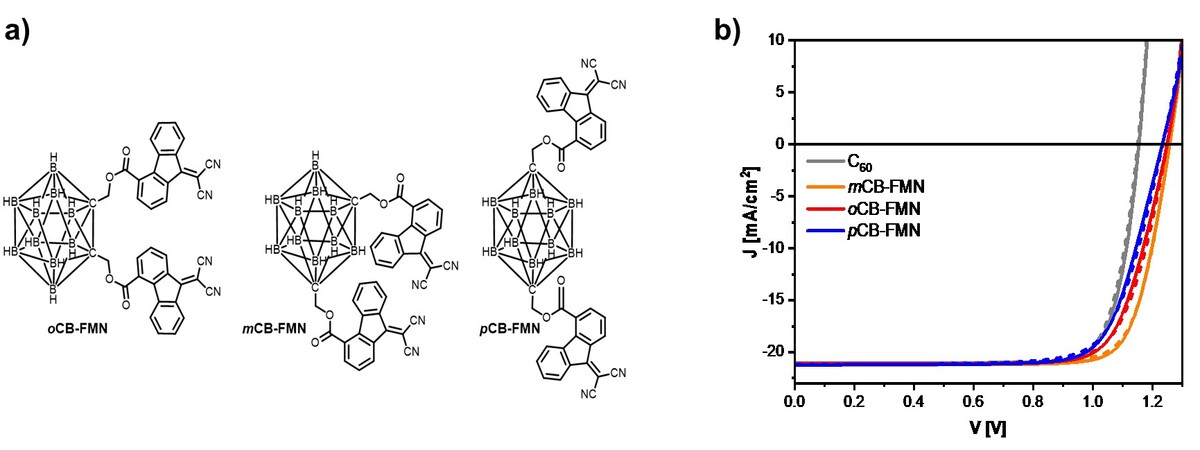
NOVEL CARBORANE-BASED ELECTRON-TRANSPORTING MATERIALS FOR PEROVSKITE SOLAR CELLS
Julius Petrulevicius1, Lea Zimmermann2, Wander Max Bernardes de Araujo2, Maxim Simmonds2, Arman Mahboubi Soufiani2, Maryte Daskeviciene1, Tadas Malinauskas1, Giedre Bubniene1, Giedrius Juska3, Vygintas Jankauskas3, Dorothee Menzel2, Florian Scheler2, Eike Köhnen2, Steve Albrecht2, Vytautas Getautis1
1 Lithuania, Kaunas University of Technology, Department of Organic Chemistry
2 Germany, Helmholtz-Zentrum Berlin, Solar Energy Division
3 Lithuania, Vilnius University, Institute of Chemical Physics
[1] “Best Research-Cell Efficiency Chart | Photovoltaic Research | NLR.” https://www.nrel.gov/pv/cell-efficiency.html
[2] J. Siekmann et al., “Characterizing the influence of charge extraction layers on the performance of Triple‐Cation perovskite solar cells,” Advanced Energy Materials, vol. 13, no. 32, Jul. 2023, doi: 10.1002/aenm.202300448.
[3] Z. Guan et al., “Ultrafast Electron‐Transfer via hybrid states at Perovskite/Fullerene Interface,” Advanced Materials, vol. 36, no. 38, p. e2407406, Jul. 2024, doi: 10.1002/adma.202407406.