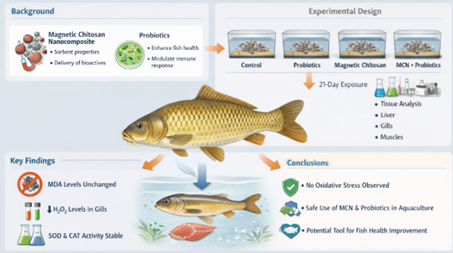
Magnetic chitosan nanocomposites (MCNs) possess a range of advantageous properties, including high surface area, magnetic responsiveness, and excellent sorption capacity, making them attractive candidates for various applications in industrial fields\(^{1}\). Due to their biocompatibility and ability to bind and deliver bioactive substances, MCNs have been proposed as carriers for functional feed additives, including probiotics. Their potential to enhance nutrient delivery, improve feed efficiency, and modulate the aquatic environment positions them as innovative tools in sustainable fish farming. Meanwhile, probiotics, live microorganisms that confer health benefits to the host, are increasingly used in aquaculture to improve gut health, immunity, and overall fish performance. However, despite their growing use, the effectiveness of probiotic supplementation, particularly in combination with nanocarriers such as MCNs, remains underexplored. A better understanding of how these agents interact within fish physiology is essential to assess their efficacy and ensure they do not induce unintended oxidative or physiological stress.
This study investigated the effects of dietary probiotics and MCNs on oxidative stress indicators in Cyprinus carpio L. over a 21-day feeding period. Fish were divided into four groups: control, probiotic-only, MCN-only, and a combination (MCN+P). Antioxidant enzyme activity and oxidative damage markers: superoxide dismutase (SOD), catalase (CAT), malondialdehyde (MDA), and hydrogen peroxide (H₂O₂) were measured in liver, gill, and muscle tissues.
The results indicated no significant increase in MDA levels across tissues, suggesting no enhancement in lipid peroxidation. H₂O₂ concentrations significantly decreased in gills in the MCN+P group, indicating reduced oxidative stress. SOD and CAT activities remained stable among groups, reinforcing the conclusion that neither probiotics nor MCNs induced oxidative stress under the tested conditions. These findings highlight the potential compatibility of probiotics and MCNs in aquaculture diets, offering a promising avenue for enhancing fish health without eliciting harmful oxidative responses.