EFFICIENT THIRD-GENERATION BLUE OLEDS USING DIBENZOFURAN-BASED HIGH-TRIPLET-ENERGY HOSTS
Kristupas Bagdonas1, Goda Grybauskaitė1, Domantas Berenis1, Gediminas Kreiza1, Edvinas Orentas2, Eigirdas Skuodis3, Karolis Kazlauskas1, Dovydas Banevičus1
1 Vilnius University, Faculty of Physics, Institute of Photonics and Nanotechnology, Vilnius, Lithuania
2 Vilnius University, Faculty of Chemistry, Department of Organic Chemistry, Vilnius, Lithuania
3 Kaunas University of Technology, Faculty of Chemical Technology, Department of Polymer Chemistry and Technology, Kaunas, Lithuania
In the field of organic light-emitting diodes (OLEDs), thermally activated delayed fluorescence (TADF) has become an established pathway toward 100% internal quantum efficiency [1]. However, optimal device performance typically requires emitter to be doped in a suitable host matrix to suppress aggregation. The host should also provide balanced charge-carrier transport and a sufficiently high triplet energy to confine triplet excitons on the emitter and prevent back energy transfer to the matrix [2].
Fig. 1. A) the chemical structures and triplet energies of hosts and emitter molecules, B) OLED external quantum efficiency dependence on brightness, C) Current densities of electron and hole single carrier devices
[1] J. M. D. Santos et al., “The Golden Age of thermally Activated Delayed Fluorescence Materials: Design and exploitation,” Chemical Reviews, vol. 124, no. 24, pp. 13736–14110, Dec. 2024, doi: 10.1021/acs.chemrev.3c00755.
[2] K. M. Youn et al., “High triplet energy bipolar host materials with the combination of dibenzofuran and benziimidazobenzoimidazole moieties for blue thermally activated delayed fluorescence emitter,” Journal of Materials Chemistry C, vol. 8, no. 39, pp. 13811–13818, Jan. 2020, doi: 10.1039/d0tc02884c.
[3] G. Kreiza et al., “High efficiency and extremely low roll-off solution- and vacuum-processed OLEDs based on isophthalonitrile blue TADF emitter,” Chemical Engineering Journal, vol. 412, p. 128574, Jan. 2021, doi: 10.1016/j.cej.2021.128574.
[4] M. Xu et al., “Analyzing exciton distribution in organic light-emitting devices using near-infrared probes,” Applied Physics Letters, vol. 122, no. 26, Jun. 2023, doi: 10.1063/5.0155469.

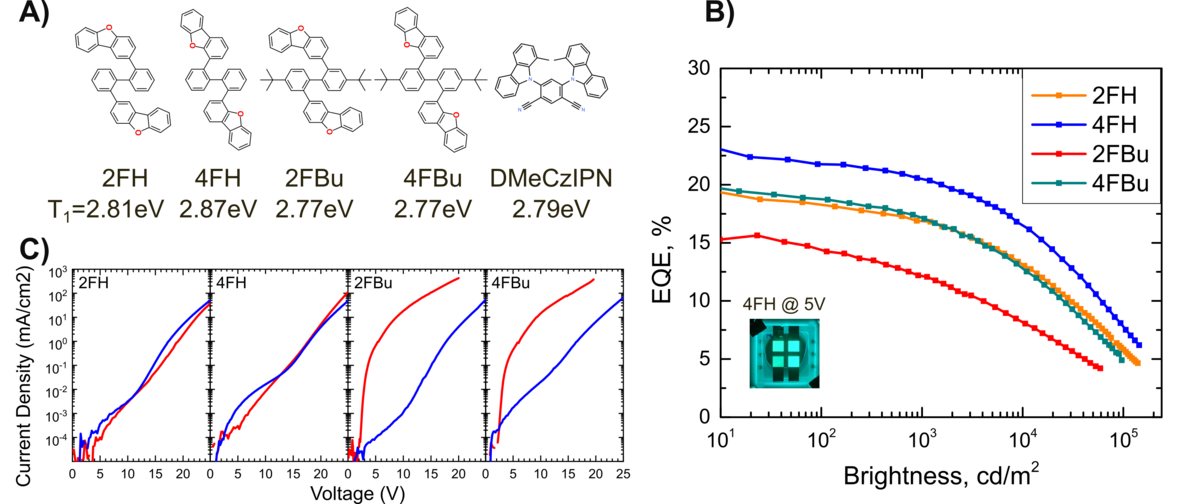 Fig. 1. A) the chemical structures and triplet energies of hosts and emitter molecules, B) OLED external quantum efficiency dependence on brightness, C) Current densities of electron and hole single carrier devices