Wearable systems that integrate sensing, communication, and protective functions require materials that are lightweight, flexible, electrically conductive, and mechanically robust. Laser-induced graphene (LIG) has emerged as a promising platform for wearable electronics due to its scalable, mask-free fabrication and excellent electrical and electrochemical properties [1]. Recent studies have demonstrated direct laser writing of graphene on high-performance polymer fabrics such as Kevlar, enabling multifunctional textile electronics that combine structural durability with active device capabilities [2]. In particular, the transformation of Kevlar fibers into conductive LIG via photothermal laser processing has enabled flexible sensors, energy storage elements, and integrated protective garments capable of physiological monitoring and environmental sensing [3]. By leveraging the intrinsic mechanical strength and thermal stability of Kevlar alongside the functional conductivity of LIG, such fiber-based architectures offer a compelling route toward next-generation wearable electronics and personal protective systems [4]. In this work, we explore the direct formation of LIG on Kevlar fibers, combining the intrinsic mechanical strength, thermal stability, and impact resistance of aramid textiles with the functional conductivity of graphene.
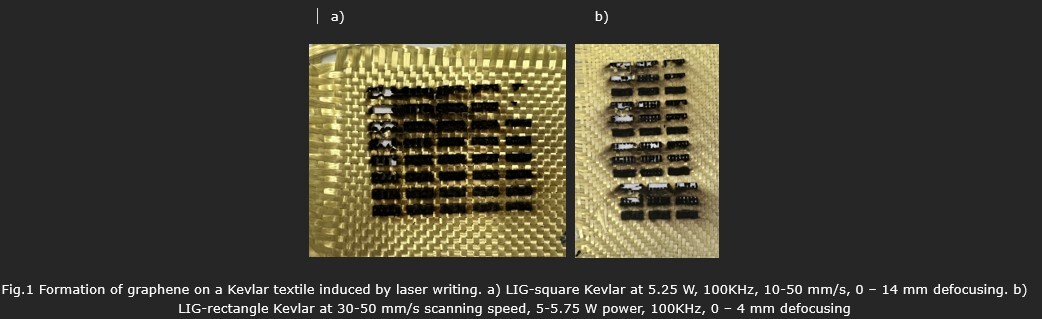
Janus laser-induced graphene (LIG) was fabricated on two yellow Kevlar substrates using two distinct nanosecond laser regimes (wavelength 532 nm and 1064 nm) to investigate their effects on composite formation for wearable electronics and protective applications. Different scanning speeds were explored at different laser powers. Laser processing enabled simultaneous LIG formation on both surfaces of the Kevlar fibers, preserving the substrate’s inherent mechanical strength and thermal stability while imparting enhanced electrical conductivity and flexibility. Sheet resistance measurements were carried out by the 4-probe method.
LIG-Kevlar composite was successfully fabricated in a range of 4,25-5,5 W and low scanning speed in a range of 10-50 mm/s. Laser regimes at 532 nm and higher scanning speeds didn’t display positive results for janus composite, while positive data was obtained at 1064 nm wavelength, 13 ns pulse duration and 100 kHz repetition rate. The squared composite is more mechanically stable than the rectangled composite, due to fiber design and its thickness 0.5 mm and 0.3 mm, respectively. Reported sheet resistance values of 4.74-69.64 Ohms/Sq at 4.25-5.5 W for the LIG-Squared Kevlar and 0-14 mm defocusing; and 6.86-64.48 Ohms/Sq at 5-6.75 W for the LIG-rectangled Kevlar and 0-4 mm defocusing.
Further experimental characterization will reveal differences in LIG morphology, electrical performance, and mechanical integrity. corresponding to each laser regimes