
Triplet-Triplet Annihilation (TTA) is a process where two low-energy triplet excitons combine to generate one high-energy singlet exciton. This mechanism holds significant potential for enhancing solar cell efficiency, deep-tissue phototherapy, 3D printing, and climate change mitigation [1-3]. An effective TTA system typically requires precise energy level alignment between two components: a long-wavelength absorbing sensitizer and a short wavelength emitter. Despite growing interest, existing literature frequently reports inconsistent photophysical parameters for identical TTA materials. These discrepancies come from varied measurement techniques and calculation methods, they hinder direct comparisons and experimental reproducibility. To address this, a systematic study of the most widely used TTA molecules was performed. By utilizing a single laboratory environment, uniform equipment, and standardized calculation protocols, a reliable and comparable dataset is provided. 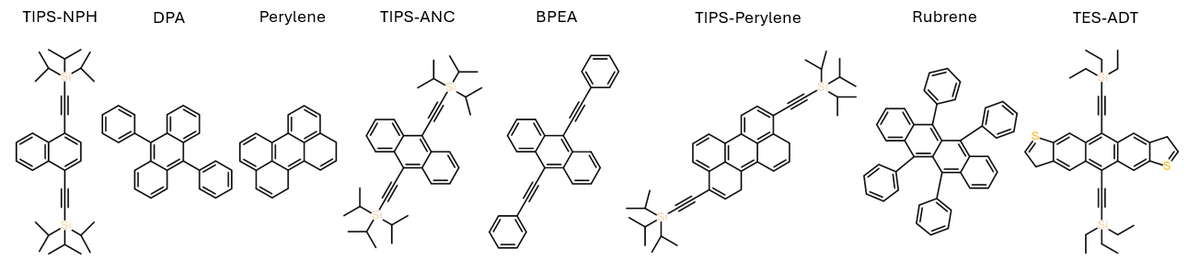
The overall photon upconversion quantum yield, \(\phi_{UC}\), can be expressed as the product of several contributing processes: \[\phi_{UC} = \frac{1}{2} f \phi_{ISC} \phi_{TET} \phi_{TTA} \phi_{FL}\] In this expression, \(\phi_{ISC}\) denotes the intersystem crossing efficiency of the sensitizer, \(\phi_{TET}\) represents the efficiency of triplet energy transfer from the sensitizer to the emitter, \(\phi_{TTA}\) is the efficiency of the triplet–triplet annihilation process, and \(\phi_{FL}\) corresponds to the fluorescence quantum yield of the emitter. The factor \(f\) accounts for the spin statistical probability of singlet state formation. Deviations from literature values are primarily attributed to differences in the methodologies used to determine fluorescence and upconversion quantum yields, with relative actinometry generally being less reliable than absolute measurements performed using an integrating sphere.