Photonic crystals are structures of periodically varying refractive index that are capable of altering and controlling the propagation of light, with potential applications as components in devices such as light emitters, optical waveguides, wavelength filters, dispersion compensators, and harmonic generators[1]. A desirable substrate for such structures is sapphire, due to its favorable mechanical, thermal, electrical, and optical properties[2]. Such photonic crystal fabrication is possible via femtosecond pulses, enabling multiphoton absorption and controllable volumetric modification of sapphire. Previous studies have focused on investigating fabrication with IR pulses, showing that cracks are a persistent obstacle in integrating photonic devices into sapphire[3]. However, use of more energetic UV photons could potentially enable crack-free fabrication of multi-layered structures using a wide range of production powers, allowing thorough control of light. In this work, fabrication via UV pulses is proposed as a viable method for 2D Laue photonic crystal integration in sapphire, enabling control of the Laue photonic crystal’s filtering effect through various parameters.
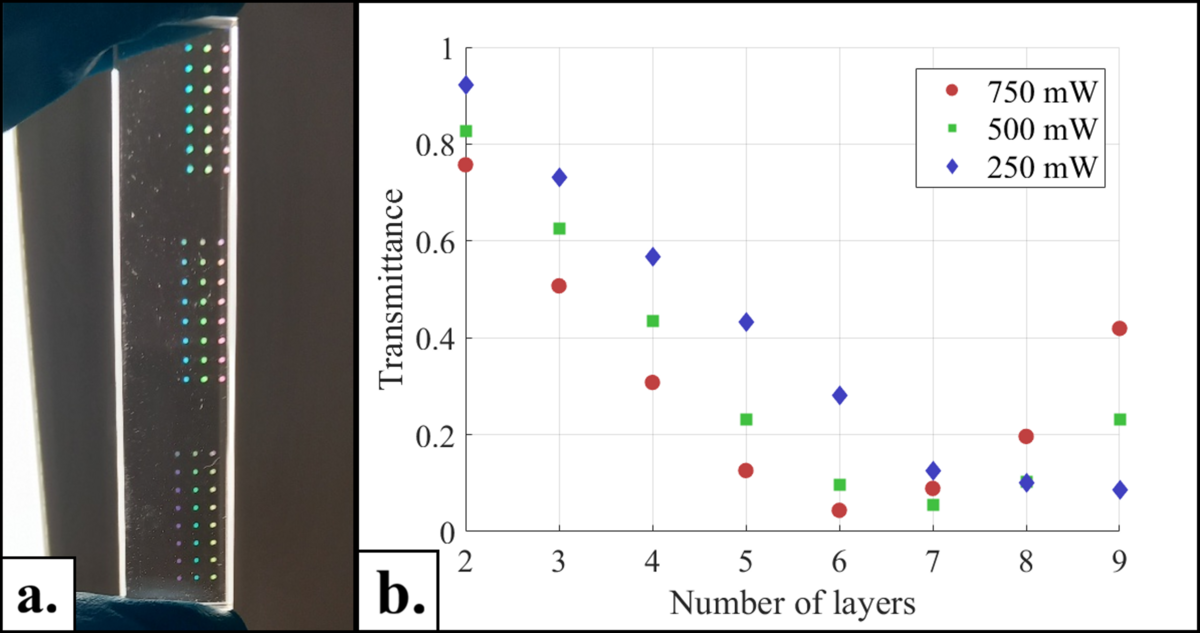
A wide range of fabrication polarization and power, as well as structure size were investigated utilizing the 1st and 4th harmonics of the Yb:KGW laser for fabrication, representing near-IR (1030 nm) and mid-UV (257 nm) wavelengths respectively. The fabrication results were investigated using microscopy and the filtering effect was characterized. Fabrication using IR pulses resulted in cracks in all but the smallest structures. 4th harmonic yielded the most promising results, with successful fabrication in all cases. (Fig. 1 a.) The filtering effect was evaluated through transmittance measurements of structures fabricated using the 4th harmonic, which revealed heavy dependence of transmittance on fabrication polarization and power, as well as number of fabricated layers. (Fig. 1 b.)
The results prove the feasibility of photonic crystal fabrication in sapphire using UV pulses over a wide range of fabrication polarizations and powers, without limitation to structure size, allowing for thorough control of the filtering effect.