
The terahertz (THz) band (0.1-10 THz) [1], usually characterised by a lack of efficient, room-temperature sensing technology, is essential for “fingerprint” gas spectroscopy, as it coincides with molecular rotational and vibrational transitions [2]. While Complementary Metal-Oxide-Semiconductor (CMOS) field-effect transistors (TeraFETs) offer a path towards compact, high-speed detection, their deployment is hindered by the lack of standardised, high-precision characterisation methodologies [3].
Broadband characterisation is primarily challenged by a “power gap” between calibrated meters and low-power sources. Standard Thomas Keating (TK) absolute power meters require minimum power levels of \(\sim\)10 µW to distinguish signals from thermal fluctuations, yet TOPTICA TeraScan 780 photomixers typically produce power below 2 µW [4]. At these levels, TK sensors operate at their noise floor, where additive thermal noise causes an artificial overestimation of the actual power. While high-sensitivity Golay cells can bridge this gap, they require meticulous cross-calibration against a traceable standard and remain highly susceptible to environmental noise [3].
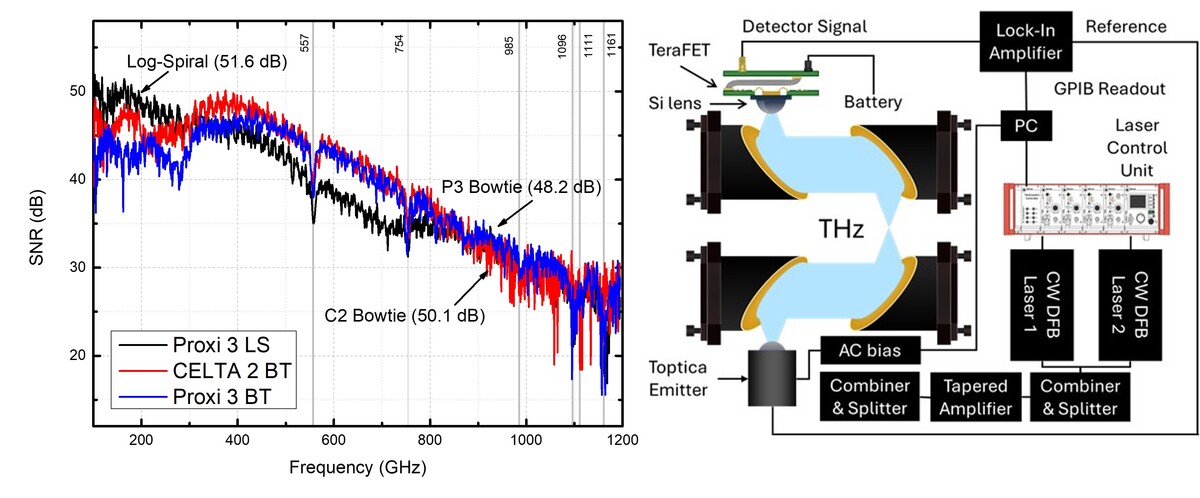
To address this, this study aimed to develop and implement a repeatable free-space platform to evaluate the broadband CMOS TeraFET sensors from 0.1 GHz to 1.2 THz. Using a TOPTICA TeraScan 780 system as a basis, with custom components for improved repeatability, three detector configurations, fabricated via 65-nm (bowtie antenna) and 90-nm (bowtie and log-spiral antennas) technology nodes, were characterised.
Results showed a 51.6 dB peak signal-to-noise ratio (SNR) for the log-spiral detector, with minimum noise equivalent power (NEP) comparable to that in the literature [3]. The platform successfully resolved the main narrow atmospheric water-vapour lines (notably 557 GHz), which were used for frequency offset calibration. While the log-spiral antenna provided the highest peak sensitivity, bowtie detectors exhibited flatter spectral response between 400 and 800 GHz.
An established characterisation platform provides a framework for benchmarking next-generation CMOS-based THz sensors. Successful resolution of atmospheric absorption features demonstrated that optimised TeraFETs can meet rigorous performance standards required for practical integration into compact gas spectroscopy systems. Future research will focus on TeraFET testing with a circular multipass cell for methanol detection.
Acknowledgement: We would like to thank doc. dr. Dalius Seliuta and Terahertz Photonics Laboratory for all the assistance during the experimental preparation.