
Multi-resonance thermally activated delayed fluorescent (MR-TADF) emitters are leading candidates for BT. 2020-standard-compatible blue organic light-emitting diodes (OLEDs) because they combine intrinsically narrow emission spectra and high PL quantum yields [1]. Recent advances in boron–oxygen π-conjugated donor–acceptor architectures exhibiting multi-resonant characteristics have enabled PL quantum yields approaching unity while maintaining full widths at half maximum below 30 nm [2]. However, in TADF-sensitized fluorescence (TSF or hyperfluorescence) architectures, limited reverse intersystem crossing (RISC) in the terminal MR-TADF emitters can promote triplet accumulation, accelerating triplet–triplet and triplet–polaron annihilation and contributing to efficiency roll-off and reduced operational stability, particularly under high-brightness operation [2]. RISC is a thermally activated spin-flip process that enables the up-conversion of long-lived non-emissive triplet excitons into emissive singlet states when a sufficiently small singlet–triplet energy splitting is achieved. Because the RISC rate directly governs triplet depopulation, efficient RISC is essential not only for maximizing exciton harvesting efficiency but also for suppressing triplet–driven loss and other degradation pathways, thereby improving device stability. 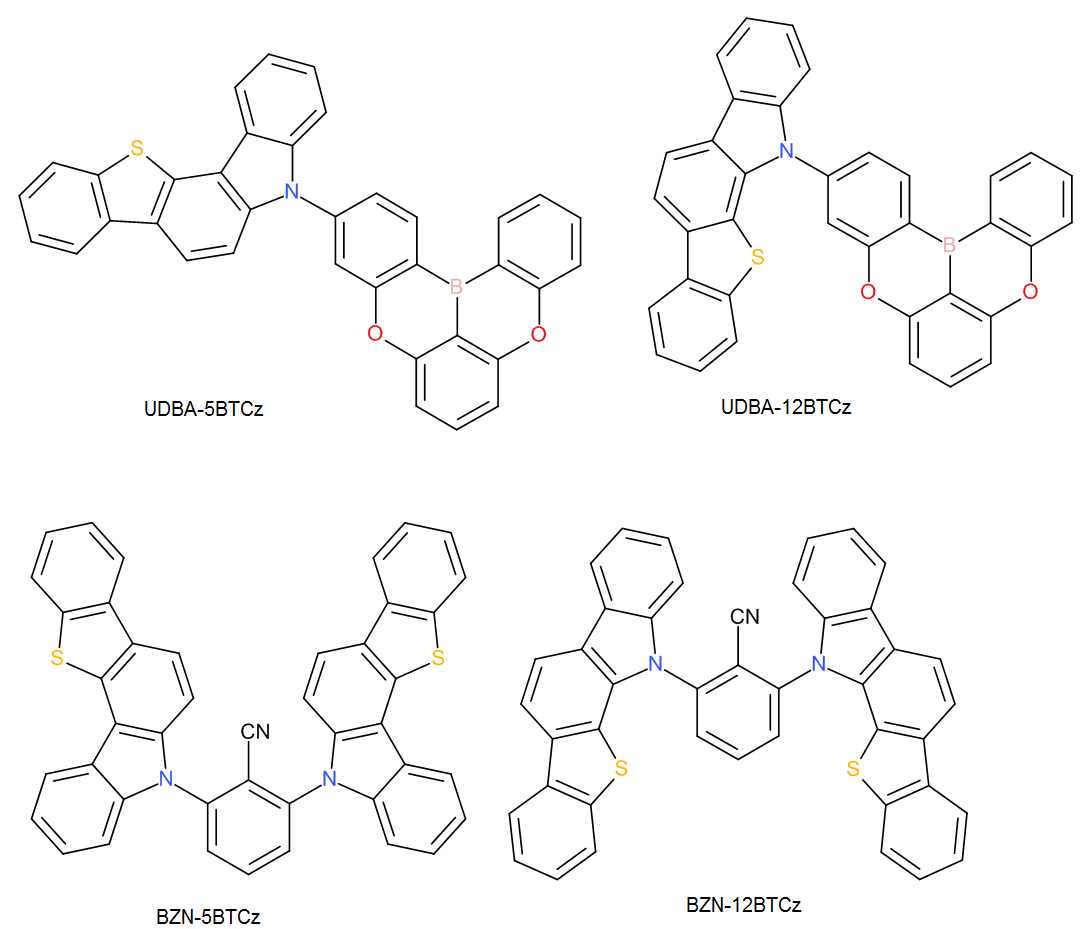
In this work, a series of blue MR-TADF emitters (Fig. 1) was rationally designed to increase spin-orbit coupling via sulphur-containing structural motifs (internal heavy-atom/heteroatom effect) while preserving the rigid multi-resonant framework that underpins narrowband emission. To isolate the impact of this design element, these MR-TADF emitters were systematically compared with conventional TADF counterparts bearing the same sulphur functionality. Photophysical properties were comprehensively investigated in toluene solution and solid-state thin films using steady-state and time-resolved spectroscopic techniques. The newly developed emitters exhibit photophysical characteristics well-suited for application as terminal emitters in next-generation TSF devices.