The interest of the application of accurate, inexpensive, sensitive, selective, miniature and rapid response electrochemical biosensors and biofuel cells, in the clinical and pharmaceutical chemistry, drug discovery, food and environmental monitoring has been increased in the last few decades [1]. The blood glucose concentration is the major of diagnostic criterion for the diabetes mellitus due the accurate and chronic effects of diabetes and is a useful tool for the patient monitoring [2]. Enzymatic (glucose oxidase (GOx)) electrochemical biosensors containing redox inorganic, organic or metal-organic mediators are characterized by high current density and stability due the incensement of FAD-GOx rate catalysed glucose electrooxidation [2]. Dendritic gold nanostructures (DGNS) are considering as one of novel nanomaterials and are presenting great promise in electronics and biomedical applications [3]. Polypyrrole (Ppy) has been receiving great interest in clinical and environmental practises due efficient transfer of electric charge and flexibility in available chemical structure [1].
The main aim of the present study was to choose more suitable redox mediator (ferrocenecarboxylic acid, 1,10-phenathroline-5,6-dione (PD), N,N,N’,N’-tetramethylbenzidine or tetrathiafulvalene) for the reagentless glucose enzymatic biosensors based on graphite rod (GR) electrode modified by electrochemically synthesized DGNS development and to investigate the influence of Ppy layer on those biosensors, to evaluate the analytical characteristics and to applicate the analytical system to determine glucose levels in the sample of serum.
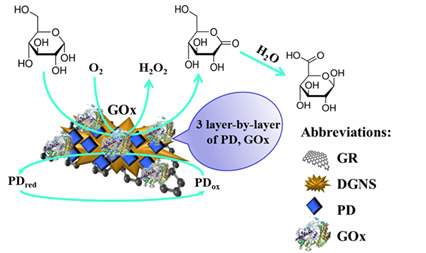
It was investigated that enzymatic biosensor based 3 layer-by-layer PD and GOx (GR/DGNS/PD*/GOx, Fig. 1) was more suitable for the determination of glucose. To improve analytical characteristics of developed biosensor the surface of GR/DGNS/PD*/GOx electrode was modified 5 h by Ppy. Glucose biosensors based on GR/DGNS/PD*/GOx or GR/DGNS/PD*/GOx/Ppy\(_{(5h)}\) electrodes were characterized by the linearity until 16.5 and 39.0 mmol L\(^{-1}\), the sensitivity of 13.4 and 3.03 μA mM\(^{-1}\) cm\(^{-2}\), the limit of detection of 0.114 and 0.683 mmol L\(^{-1}\), the repeatability for 29.4 mmol L\(^{-1}\) glucose concentration of 9.10 and 10.3%, respectively. The Ppy-based glucose biosensor was characterized by good storage stability (until 9 days) and successful practical application in the sample of serum (97.5–98.0% of recovery).