MOLECULAR ENGINEERING OF ETHYLCARBAZOLE DERIVATIVES FOR HIGHLY EFFICIENT OLED HOST MATERIALS
Dovydas Blazevicius1, Raminta Beresneviciute1, Ernestas Kasparavicius1, Julius Petrulevicius1, Gintare Krucaite1, Saulius Grigalevicius1, Chih-Hung Ko2, Cai-Fan Lo2, Chih-Hao Chang2
1 Lithuania, Kaunas University of Technology, Faculty of Chemical Technology, Department of Polymer Chemistry and Technology
2 Taiwan, Yuan Ze University, Department of Electrical Engineering
Organic light-emitting diodes (OLEDs) have garnered significant scientific and industrial attention due to advantages ranging from innovative product design possibilities to highly efficient and sustainable light sources, creating amdemand for new high-performance materials. Although state-of-the-art OLEDs now exceed 30% EQE, challenges such as amorphous layer instability, exciton quenching, and efficiency roll-off persist, making device performance and operational stability strongly dependent on the molecular design of the organic layers. Among these, the host material in the emissive layer plays a particularly critical role, especially in phosphorescent and TADF OLEDs, where efficient management of both singlet and triplet excitons is required [1, 2].
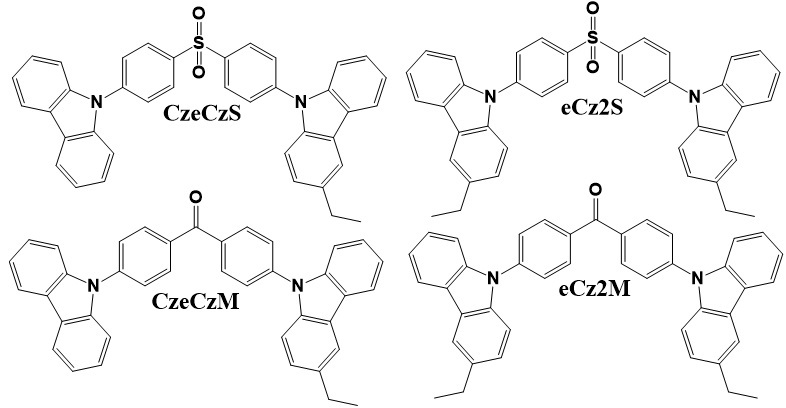
Fig. 1. Structures of newly synthesized ethylcarbazole derivatives
Addressing this need, new ethylcarbazole-based D-A-D host materials were synthesized using one- or two-step nucleophilic aromatic substitution routes and evaluated for their suitability in OLEDs. Materials had one (CzeCzS, CzeCzM) or two (eCz2S, eCz2M) ethylcarbazole units paired with either sulfonyl (CzeCzS, eCz2S) or methanone (CzeCzM, eCz2M) electron acceptors. Thermal and morphological analyses showed that all materials are highly resistant to degradation, with decomposition temperatures ranging from 393 to 436 °C, and they form stable amorphous films with high Tg values (89–112 °C). Photophysical measurements revealed high triplet state energies (2.71 – 2.90 eV), indicating that these compounds can serve as hosts for both green phosphorescent and yellow TADF emitters. Device studies highlighted that methanone-bridged hosts outperformed phenylsulfonyl analogues due to more balanced charge transport and improved exciton confinement. When applied as host materials to green phosphorescent emitter, maximum EQE of 16.5% was achieved. Incorporating these hosts into blended co-host architectures led to notable efficiency enhancements with external quantum efficiency values surpassing 20%. The best-performing device, based on the eCz2M:B3PyMPM co-host system, achieved an EQE of 20.3%, a luminance efficiency of 72.7 cd/A, and a power efficiency of 95.1 lm/W. Also, for yellow emitting TADF OLED prototype our co-host systems enabled to achieve an EQE of 10.3%. This work demonstrates that methanone-ethylcarbazole D-A-D structures are strong candidates for next generation efficient OLED host materials. This work provides fundamental knowledge for developing advanced host materials for both TADF and phosphorescent OLED technologies. ) and for support from the Faculty of Chemistry and Chemical Technology of Kaunas University of Technology
Acknowledgments: We acknowledge support from the Research Council of Lithuania (grant No. S-MIP-25-23
[1] C. Van Hoesel, R. Coehoorn, and P. A. Bobbert, “Theoretical study of host-guest exciton-polaron quenching rates in phosphorescent OLED emission layers,” SPIE, p. 9, Jan. 2023, doi: 10.1117/12.2645104.
[2] G. Kreiza et al., “Suppression of benzophenone-induced triplet quenching for enhanced TADF performance,” Journal of Materials Chemistry C, vol. 7, no. 37, pp. 11522–11531, Jan. 2019, doi: 10.1039/c9tc02408e.