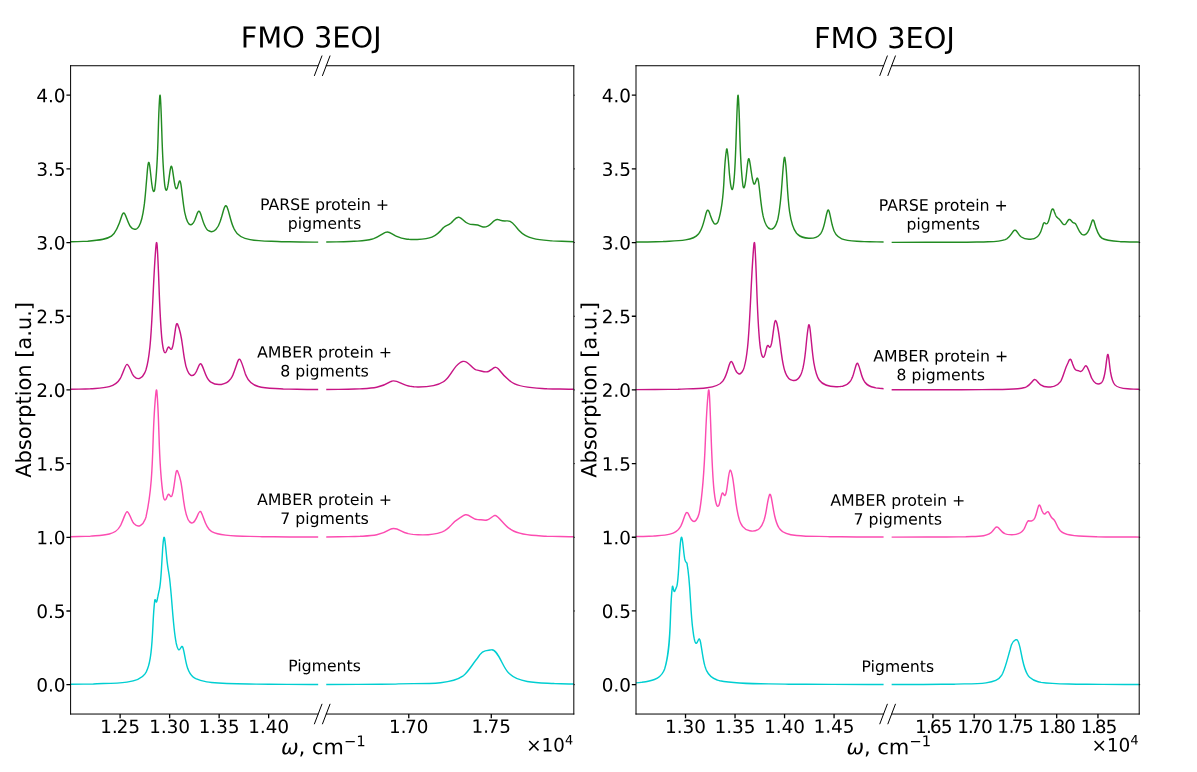
One of the core processes of photosynthesis is the “collection of the light energy” through excitations of multi-pigment light-harvesting antenna complexes. A vast diversity of photosynthetic pigments and light-harvesting complexes has evolved that adapted the process to occur both in water and on land, and it can be found in many bacteria, algae, and plant species. In this work, we extend the standard exciton model typically used to calculate various types of spectra of the light-harvesting complexes. The standard exciton theory used for describing the spectroscopy of molecular complexes usually assumes an infinite exciton lifetime, coming from complete isolation of Hamiltonian blocks describing a different number of excitations. We focus on extending the model by including environment-induced non-resonant couplings in the Hamiltonian, which couple different numbers of excitons. We analyze their impact on the absorption spectra of two small light-harvesting complexes from their crystallographic structure: Fenna–Matthews–Olson and fucoxanthin–chlorophyll protein. Quantum mechanics calculations of the pigment properties, combined with electro-static description of the protein, allowed us to construct the full Hamiltonian and calculate the exciton lifetimes and the absorption spectra using the secular Redfield theory. The results of the research indicated that off-resonant terms in the Hamiltonian are significant: they are at least one order of magnitude larger than the interchromophore resonant interactions and allow the estimation of each exciton lifetime, therefore should be included in the calculations of linear (or non-linear) spectra. Therefore, as the results proved to be consequential, the methodology of this model was advanced: molecular dynamics simulations have been performed for the protein and its ligands to get closer to real-life conditions than a single crystallographic structure. The molecular dynamics simulations allowed us to obtain correlation functions and spectral densities of the Fenna–Matthews–Olson complex with the off-resonant terms and to focus on developing the complex Redfield theory extension including the off-resonant terms for absorption calculations.