Reducing electromagnetic (EM) wave reflections is essential for stealth applications and minimising unwanted radar signals. Conventional metallic surfaces strongly reflect incident EM waves, making them easily detectable by radar systems. Metasurface-based structures made of subwavelength elements that can control the phase, amplitude, and polarization of electromagnetic waves, with properties not found in conventional natural materials-offer a promising way to reduce reflections without relying on bulky or thick absorbers [1].
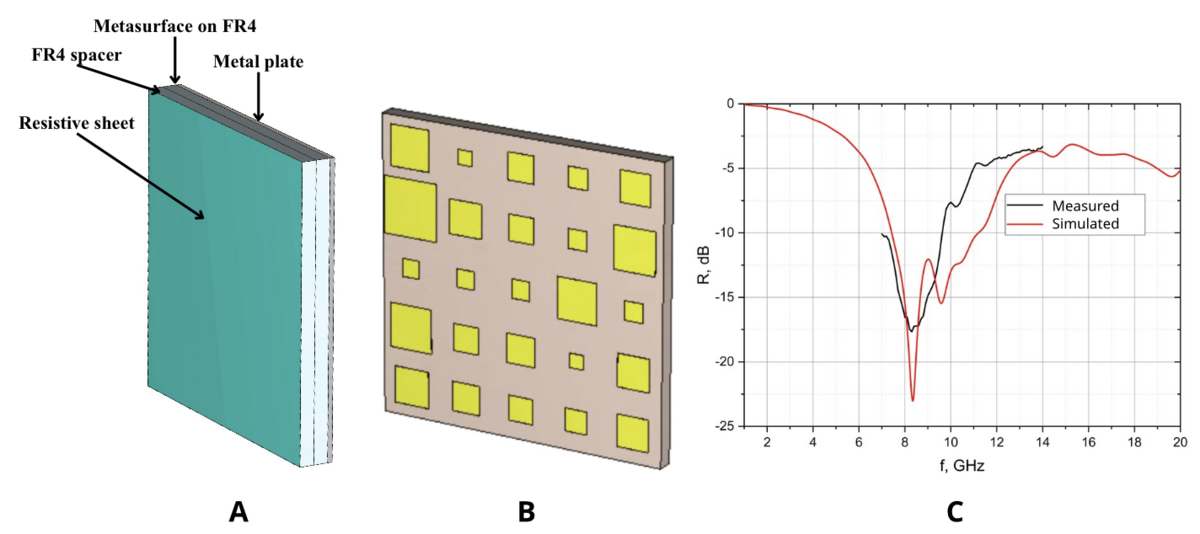
This study presents a multilayer Salisbury-type structure incorporating a metasurface designed to reduce EM reflections in the X-band frequency range. The proposed structure is implemented on a rigid FR4 substrate, prioritizing mechanical stability. The multilayer configuration, shown schematically in Fig. 1(A), consists of a fully coated resistive textile layer serving as the first interface with the incident EM wave, followed by a dielectric spacer. Beneath this spacer, a metasurface patterned on FR4 is introduced, backed by a continuous metal plate.
The metasurface unit cell, illustrated in Fig. 1(B), is composed of 25 metallic squares with varying dimensions arranged in a non-uniform array. The elements were fabricated on an FR4 substrate with a copper layer using photolithography. Their dimensions were optimized using a genetic algorithm, a population-based optimization method inspired by natural evolution. The optimization objective was to minimize electromagnetic reflection within the X-band (8–12 GHz). Electromagnetic simulations were performed in CST Studio Suite, using periodic boundary conditions to model an infinite-size metasurface array, enabling efficient evaluation and convergence toward an optimal design.
Reflection reduction is achieved through destructive interference between incident and reflected waves. The wave reflected from the metal plate undergoes a 180° phase shift, destructively interfering with the wave reflected from the upper layers and suppressing overall reflection. As shown in Fig. 1(C), both simulated and measured reflection coefficients exhibit a pronounced resonance within the X-band, with a maximum reflection reduction of up to −15 dB around 8–9 GHz. The close agreement between simulation and measurement confirms the validity of the proposed multilayer design and the accuracy of the simulation model.
The optimized multilayer structure shows clear resonance behavior typical of Salisbury screens, further improved by the by the metasurface. The proposed design offers an effective and practical solution for reducing radar reflections in the X-band and can be adapted to other frequency bands and stealth applications.